Rental Property Calculator & ROI Estimator
Estimate rental income, cash flow, cap rate, and investment returns.
Property & Purchase
Rental Income
Operating Expenses
Financing
Your Results
Calculation
A Rental Property Calculator & ROI Estimator helps investors turn a long list of property assumptions into clear numbers they can review before making a decision. Instead of guessing whether a property will produce positive cash flow, you can enter the purchase price, financing details, expected rent, vacancy, and operating expenses to estimate net income and return.
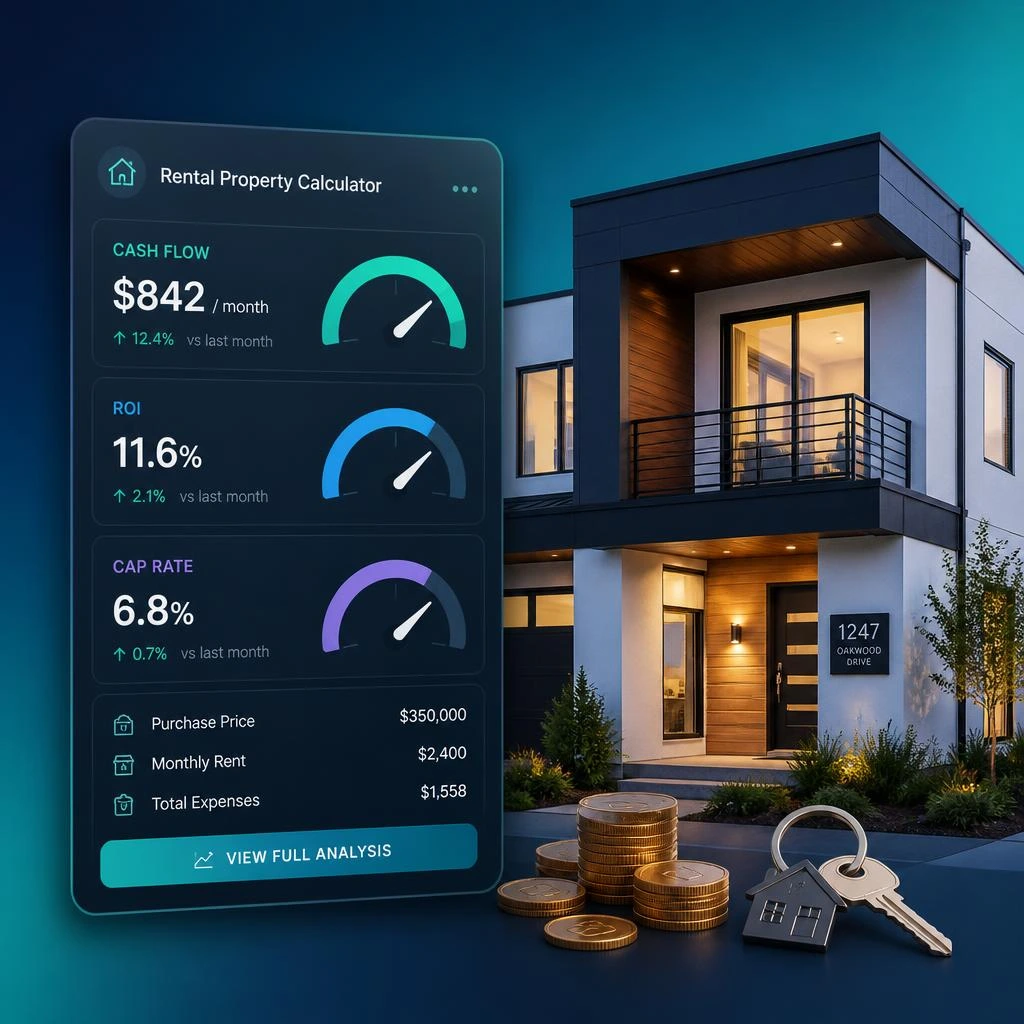
The calculator does not predict the future, and it does not replace professional advice. It simply organizes your assumptions. That matters because rental property results depend on actual income, expenses, financing, vacancy, taxes, maintenance, and market conditions. A property can look profitable on a flyer and still perform poorly if expenses are underestimated. Reviewing rental income, cash flow, cap rate, cash-on-cash return, and overall ROI before buying or refinancing helps you compare opportunities and spot weak assumptions early.
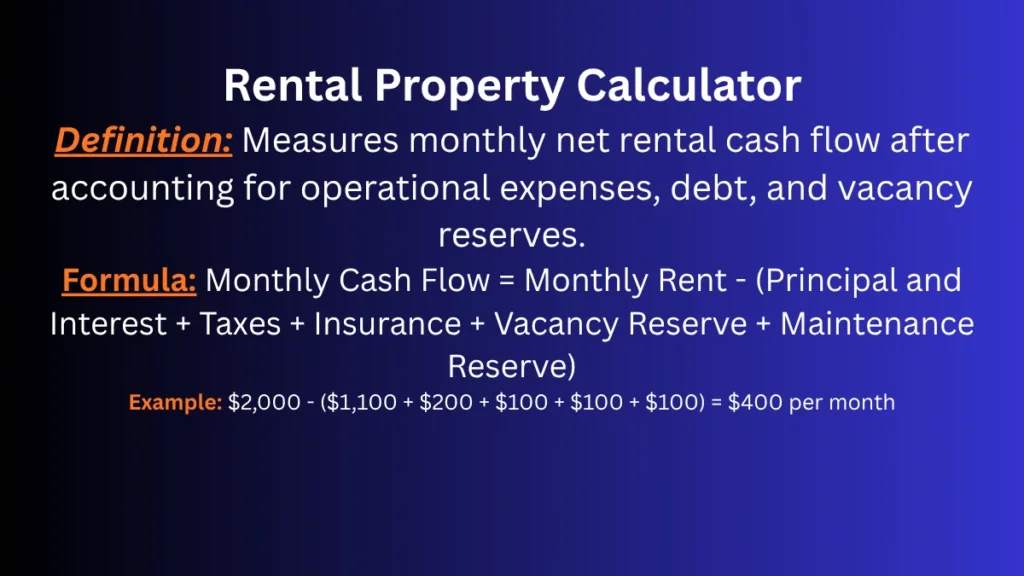
What Is a Rental Property Calculator?
A rental property calculator is a tool that estimates the financial performance of an investment property. You enter information about the property, the financing, and your assumptions, and the calculator produces estimated outputs such as monthly cash flow, net operating income, cap rate, cash-on-cash return, and total ROI.
Most calculators ask for some version of the following:
- Purchase price and closing costs
- Down payment and loan terms
- Monthly rent and other income
- Vacancy rate
- Property taxes, insurance, and HOA fees
- Maintenance and property management costs
- Mortgage payment and other debt service
Some tools also include appreciation, rent growth, and selling costs. The more honest your inputs, the more useful the output. A rental property calculator is only as good as the assumptions behind it.
What Is Rental Property ROI?
Rental property ROI measures how much return an investment produces relative to the money you put into it. In simple terms, it answers a basic question: for every dollar invested, how much annual return does the property generate?
The basic ROI formula is:
ROI = (Annual Return ÷ Total Cash Invested) × 100
ROI is not the same as monthly cash flow. Cash flow is the money left after operating expenses and debt payments. ROI looks at return relative to the total cash invested, which may include the down payment, closing costs, rehab, and other upfront costs. A property can produce strong monthly cash flow but a modest ROI if you invested a large amount of cash. Another property might show lower cash flow but a higher ROI because less cash was tied up.
ROI also depends on how you define return. Some investors count only annual cash flow. Others include principal paydown, appreciation, or tax benefits. Because of that, ROI figures are not always directly comparable between properties. If you are reviewing property value alongside rental income, a commercial property valuation tool can help you check whether the asking price is reasonable relative to the income the property produces. You can also use a cap rate formula to cross-check the valuation from an income perspective.
How a Rental Property ROI Estimator Works
A rental property ROI estimator takes your inputs and walks through a series of calculations. It usually starts with rental income, subtracts operating expenses to find net operating income, then subtracts debt payments to estimate cash flow. From there, it compares annual return to the cash invested.
Here are the main inputs and why they matter:
| Input | What It Means | Why It Matters |
|---|---|---|
| Purchase price | The price paid for the property | Sets the base for financing, closing costs, and ROI |
| Down payment | Cash paid upfront toward the purchase | Reduces the loan but increases cash invested |
| Closing costs | Fees paid at closing | Adds to total cash invested and lowers ROI |
| Monthly rent | Expected rental income per month | Primary source of income for the property |
| Vacancy rate | Percentage of time the unit sits empty | Reduces effective rental income |
| Property taxes | Annual tax assessed by local authorities | A required operating expense |
| Insurance | Landlord insurance premium | Protects the property and affects expenses |
| Maintenance | Ongoing repair and upkeep costs | Often underestimated by new investors |
| Property management | Fee paid to a manager | Common expense if you do not self-manage |
| Mortgage payment | Principal and interest paid to the lender | Affects cash flow but not net operating income |
| Other operating expenses | HOA, utilities, advertising, legal, accounting | Can significantly reduce net income |
The calculator combines these inputs to produce estimates. It does not know the future, and it cannot verify whether your rent estimate is realistic. That is your job.
Rental Income Calculator: How to Estimate Rental Income
A rental income calculator helps you estimate what a property can realistically earn before you commit to a purchase. Estimating rental income is not about guessing a round number. It is about reviewing comparable rents, vacancy trends, and the difference between potential income and actual income. A rental income estimator gives you a starting point, but the quality of the estimate depends on the assumptions you feed into it.
To estimate fair market rent, start with recent rental listings for similar properties in the same area. Look at square footage, bedroom count, condition, and amenities. A rental property income calculator works best when the rent input reflects what tenants are actually paying today, not what you hope they will pay. Review at least five comparable rentals before entering a number.
A fair rental value calculator typically uses rent comparables, property condition, and local demand to produce an estimate. You can replicate this manually by averaging the rents of three to five similar units and adjusting for differences in size, age, and features. The goal of any rental income calculator is to produce a realistic number, not the highest possible number.
A rental value of property calculator estimates what a specific property should rent for based on its characteristics. When you use this type of rental income estimator, compare the output against actual listings, not asking rents that have sat vacant for months. Realistic inputs make the rental income calculator useful. Inflated inputs make it misleading.
Potential rental income assumes full occupancy at the asking rent. Actual rental income accounts for vacancy, concessions, and non-payment. A rental property income calculator that ignores this difference will overstate returns. Use your rental income estimator with a realistic vacancy rate so the rental income calculator reflects what you will actually collect.
Rental Property Cash Flow Calculator: From NOI to Monthly Cash Flow
Cash flow is the money left over after the property pays its bills. It is one of the most practical measures of rental property performance because it shows whether the property supports itself.
The basic formula is:
Annual Cash Flow = Annual Rental Income − Annual Operating Expenses − Annual Debt Payments
Each part matters:
- Annual rental income is the total rent collected over a year. If monthly rent is $2,000, gross annual rental income is $24,000 before vacancy.
- Annual operating expenses include property taxes, insurance, maintenance, management fees, HOA dues, utilities paid by the owner, and other costs of running the property.
- Annual debt payments are the mortgage payments, including principal and interest. Some investors also include other debt secured by the property.
A rental cash flow calculator typically subtracts operating expenses first to find net operating income, then subtracts debt service to estimate cash flow. If the result is positive, the property is estimated to produce cash flow. If it is negative, the owner may need to cover the shortfall from other income.
A NOI calculator rental property tool subtracts operating expenses from effective gross income. The rental noi calculator formula is:
NOI = Effective Gross Income − Operating Expenses
A noi on rental property review should exclude mortgage payments. If you are using a rental property noi calculator, confirm that debt service is not included. A rental noi calculator that mixes financing costs into NOI will produce an incorrect result.
A rental property break even calculator shows the occupancy level needed to cover all expenses. A rental break even calculator helps you see how much vacancy the property can absorb. Use a break even calculator for rental property before you buy. A rental property break even calculator that ignores debt service will understate the break-even point.
Positive cash flow means the property covers its bills and produces surplus. A positive cash flow property calculator shows this number. A positive cashflow property calculator should separate pre-tax and after-tax cash flow. Use a positive cash flow property calculator to compare properties on the same basis.
Cash flow timing matters. A cash conversion cycle calculator helps you see how long cash is tied up. A working capital calculator helps you estimate the reserves needed to cover shortfalls. If cash flow turns negative, a startup burn rate calculator offers a useful analogy for how long reserves will last. For properties with receivables, an invoice factoring calculator shows the cost of accelerating cash.
Rental Profit Calculator: How to Measure Profit Per Property
A rental profit calculator shows what a property earns after all expenses and debt payments are subtracted. Profit is not the same as rent collected. A rental property profit calculator separates gross income from net profit so you can see whether the property actually makes money. Investors who rely only on rent figures often miss the true cost of ownership.
Gross profit is rent minus operating expenses. Net profit is what remains after debt service. A rental profit calculator should show both figures. When you use a rental house profit calculator, the net number is the one that matters for cash flow. A property with strong gross profit can still produce weak net profit if debt service is high.
The basic formula a rental property profit calculator uses is:
Net Profit = Rental Income − Operating Expenses − Debt Service
A landlord profit calculator applies the same formula. If you want to see profit per unit, divide the result by the number of units. A rental income profit calculator helps you compare properties using the same formula so the comparison is fair.
Several factors reduce profit quickly: vacancy, deferred maintenance, high management fees, and rising insurance. A rental home profit calculator can show how a small change in one assumption affects the result. Running the numbers through a rental profit calculator before you buy helps you spot these issues early.
Profit margin matters. An EBITDA margin calculator provides a comparison framework for evaluating operating efficiency across properties.
How to Calculate Rental Property ROI
ROI compares annual return to the total cash invested. A simple version looks like this:
ROI = Annual Return ÷ Total Cash Invested × 100
If a property produces $4,000 in annual return and you invested $50,000 in cash, the estimated ROI is 8%.
The challenge is that investors define both annual return and total cash invested differently.
Annual return might include:
- Cash flow
- Principal paydown
- Appreciation
- Tax benefits
Total cash invested might include:
- Down payment
- Closing costs
- Rehab costs
- Other upfront expenses
Because of these differences, two investors can look at the same property and calculate different ROI figures. That does not mean one is wrong. It means they are measuring different things. A rental property return calculator helps you stay consistent so you can compare properties using the same assumptions.
A percentage increase calculator helps you measure ROI improvement between scenarios.
Rental Investment Calculator: Evaluating a Deal
A rental investment calculator helps you evaluate whether a property is worth buying. It combines purchase price, financing, income, and expenses into a single view. A rental property investment calculator is useful because it forces you to look at the whole deal, not just the rent. Investors who skip this step often rely on emotion instead of numbers.
A real estate investment calculator should produce at least four metrics: cash flow, cap rate, cash-on-cash return, and total ROI. An investment property calculator that only shows one metric gives an incomplete picture. Use a rental investment calculator that shows all four so you can compare deals consistently.
To analyze a rental property, enter the purchase price and financing terms, add realistic rental income and vacancy, enter all operating expenses, review net operating income and cash flow, and compare ROI against your target. A rental property analysis calculator follows this same sequence. If you use an investment property analysis calculator, check that it separates operating expenses from debt service. A rental property investment calculator that mixes the two will give you a misleading picture.
Before using any analyze rental property calculator, gather the purchase price and closing costs, down payment and loan terms, monthly rent and vacancy rate, property taxes and insurance, maintenance and management costs, and HOA fees and utilities. A rental property evaluator is only as good as the inputs. An evaluating rental property investment calculator will produce a useful result only when the checklist above is complete.
Cap Rate Calculator: Formula & Real Estate Application
A cap rate calculator real estate tool measures net operating income relative to property value. Cap rate is one of the most widely used metrics in real estate because it ignores financing. The cap rate formula real estate professionals use is:
Cap Rate = Net Operating Income ÷ Property Value × 100
To calculate cap rate on rental property, divide NOI by the purchase price. A cap rate calculator real estate does this automatically. If you are calculating cap rate on rental property manually, confirm that NOI excludes mortgage payments. Including debt service in NOI is a common error that produces an incorrect cap rate formula real estate result.
A cap rate rental calculator lets you compare properties in different markets. A cap rate rental property formula applied consistently across deals shows which properties produce more income per dollar of value. When you use a rental property cap rate formula, compare similar property types. A cap rate rental calculator is not useful for comparing a single-family rental against a commercial building.
Cap rate ignores financing, vacancy differences, and capital expenditures. A rental cap rate calculator will not tell you whether a property cash flows after debt service. When you use a cap rate rental property formula, treat the result as one input, not the final answer. A determining cap rate on rental property analysis should always be paired with cash flow and ROI review.
If you want to review capitalization rate separately, a cap rate formula calculator can help you calculate it quickly. For commercial properties, a debt yield calculator provides an additional lens on lender requirements.
Cap Rate vs Cash-on-Cash Return vs ROI
Cap rate, cash-on-cash return, and ROI are related, but they answer different questions. None of them is universally better than the others.
| Metric | What It Measures | Common Use | Main Limitation |
|---|---|---|---|
| Cap rate | Net operating income relative to property value | Comparing properties without financing | Ignores debt and cash invested |
| Cash-on-cash return | Annual pre-tax cash flow relative to cash invested | Measuring cash return on upfront cash | Ignores appreciation and principal paydown |
| Total ROI | Overall return relative to total cash invested | Evaluating total performance | Depends heavily on how return is defined |
Cap rate, or capitalization rate, is calculated by dividing net operating income by property value or purchase price. It is useful for comparing properties because it ignores financing. If you want to review capitalization rate separately, a cap rate calculator can help you calculate it quickly.
Cash-on-cash return focuses on cash flow relative to the cash you invested. It is popular with investors who care about monthly or annual cash returns.
Total ROI is broader. It can include cash flow, principal paydown, appreciation, and other factors. Because it is more flexible, it can also be more subjective.
Gross Rent Multiplier (GRM): Formula & When to Use It
The gross rent multiplier formula is a quick screening tool. It compares property price to gross annual rent. The gross rent multiplier formula is:
GRM = Property Price ÷ Annual Gross Rent
A gross rental multiplier calculator produces a single number. A lower gross monthly rent multiplier suggests the property is priced lower relative to its income. The gross rent multiplier formula is useful for a first-pass screen, but it ignores expenses. An annual gross rent multiplier calculation should never replace a full cash flow analysis.
There is no universal answer for what makes a good GRM. A gross rental multiplier calculator result depends on the market, property type, and expense load. A gross monthly rent multiplier that looks attractive in one market may be normal in another. Use the gross rent multiplier formula to filter deals, then run a full analysis before making an offer.
GRM uses gross rent. Cap rate uses net operating income. A gross rental multiplier calculator is faster, but a cap rate analysis is more accurate. The gross rent multiplier formula is best used as a first filter. Once a property passes the GRM screen, run a full cash flow and ROI analysis.
Price-to-Rent Ratio Calculator
A price to rent ratio calculator compares home prices to annual rents in a market. The price to rent ratio calculator is:
Price-to-Rent Ratio = Median Home Price ÷ Median Annual Rent
A rent to property value calculator applies the same idea at the property level. A rent to value ratio calculator helps you see whether a specific property is priced reasonably relative to its income. The price to rent ratio calculator is most useful when comparing multiple markets or neighborhoods.
A rent to property value calculator result above 20 often suggests a market where buying is expensive relative to renting. A rent ratio calculator below 15 often suggests the opposite. A rent to sale price calculator gives you a quick sense of whether the market favors buyers or renters.
A house price to rent calculator is a screening tool, not a decision tool. A rent to property value ratio calculator result should be combined with cash flow and ROI analysis. Use the price to rent ratio calculator to narrow your search, then run the full numbers before committing.
What Expenses Should Be Included in a Rental Property Analysis?
A rental property analysis should include all recurring costs associated with owning and operating the property. Missing even one expense can make a property look more profitable than it really is.
Common expenses include:
- Mortgage interest
- Principal payment
- Property taxes
- Landlord insurance
- Maintenance
- Repairs
- Property management fees
- Vacancy
- Utilities paid by the owner
- HOA fees where applicable
- Advertising or leasing costs
- Legal and accounting costs where applicable
Here is a simple way to organize them:
| Expense | Monthly Estimate | Annual Impact |
|---|---|---|
| Property taxes | $300 | $3,600 |
| Landlord insurance | $120 | $1,440 |
| Maintenance | $150 | $1,800 |
| Property management | $160 | $1,920 |
| Vacancy allowance | $160 | $1,920 |
| HOA fees | $50 | $600 |
| Utilities paid by owner | $80 | $960 |
These numbers are only examples. Your actual costs will depend on the property, location, condition, and local market. The important point is to include them before you review cash flow or ROI.
A rental property expense calculator should include every recurring cost. A rental property expenses calculator that misses even one line item will overstate returns. Use a rental expense calculator checklist that covers property taxes, landlord insurance, maintenance and repairs, property management fees, vacancy allowance, HOA fees, utilities paid by owner, advertising and leasing costs, and legal and accounting costs.
An investment property expenses calculator should also include a reserve for capital expenditures. A landlord costs calculator that omits reserves will understate long-term costs. Review your rental property cost calculator inputs against actual statements whenever possible. An investment property costs calculator is only useful when the inputs reflect real expenses.
Closing costs often include title fees. A title insurance calculator helps estimate this line item. If you are reviewing business overhead for a property held in an entity, a business overhead expense calculator provides a useful comparison.
How Vacancy Rate Affects Rental Property ROI
Vacancy is one of the most commonly underestimated expenses in rental property analysis. A property is rarely occupied 100% of the time. Tenants move out, repairs take time, and finding a new tenant can take weeks or months.
If you assume 100% occupancy, you are assuming perfect performance. That is not realistic for most properties.
Here is a simple illustration. Suppose a property rents for $2,000 per month. At 100% occupancy, annual rental income would be $24,000. At a 5% vacancy rate, you would subtract $1,200, leaving $22,800 in effective rental income. At 10% vacancy, the reduction is $2,400, leaving $21,600.
That difference flows directly into cash flow and ROI. A rental income calculator that ignores vacancy can overstate returns. This example is an illustration, not a prediction. Actual vacancy will vary based on the market, property condition, tenant demand, and management quality.
A percentage decrease calculator helps you measure the impact of vacancy on income. An average percentage calculator helps you average vacancy across multiple units. A time percentage calculator helps you convert vacancy days into an annual percentage.
Gross Rental Yield vs Net Rental Yield
Gross rental yield and net rental yield measure rental income differently. Gross yield looks at income before expenses. Net yield looks at income after operating expenses.
| Gross Rental Yield | Net Rental Yield |
|---|---|
| Annual rent divided by property value or purchase price | Net operating income divided by property value or purchase price |
| Ignores operating expenses | Includes operating expenses |
| Useful for a quick comparison | More realistic for profitability analysis |
| Can make a property look stronger than it is | Shows how expenses affect returns |
Gross rental yield is simple: if a property costs $300,000 and generates $30,000 in annual rent, the gross yield is 10%. Net rental yield subtracts operating expenses first. If operating expenses are $12,000, net operating income is $18,000, and net yield is 6%.
The difference matters because operating expenses can be substantial. Property taxes, insurance, maintenance, management, and vacancy all reduce the income you actually keep.
Rental Property Financing and Debt Service
Financing has a major effect on rental property cash flow and ROI. A larger down payment reduces the loan and monthly mortgage payment, but it also increases the cash invested. A smaller down payment preserves cash but increases debt service and risk.
Key financing terms include:
- Down payment
- Mortgage payment
- Interest rate
- Principal payment
- Debt service
- Loan terms
Debt service is the total amount paid toward the loan, including principal and interest. Lenders often review debt service coverage to assess whether the property’s income is sufficient to cover its debt obligations. A DSCR calculator can help you estimate the relationship between net operating income and debt service.
If you want to estimate your monthly mortgage payment or review a payment schedule, a mortgage payment calculator can be useful. Just remember that the mortgage payment is not an operating expense. It is a financing cost. That distinction matters when calculating net operating income and cap rate.
A mortgage calculator for rental property works differently from a primary residence calculator. Investment property rates are typically higher. A mortgage calculator investment property should use the investment rate, not the owner-occupied rate. An investment property loan calculator should also account for shorter terms and higher down payments.
Investment property rates vary by lender and loan type. An investment property interest rate calculator helps you compare scenarios. A rental property financing calculator should include closing costs and reserves. A rental property payoff calculator helps you see how extra payments affect the loan.
An amortization schedule for rental property shows how principal and interest split over time. A mortgage calculator for rental property that ignores amortization misses the principal paydown component of ROI. Use a mortgage calculator investment property that shows the full schedule.
A rental income calculator mortgage tool helps you see how lenders view rental income. A rental income calculation for mortgage loan typically applies a vacancy factor. To calculate rental income for mortgage qualification, lenders may use 75% of gross rent. A mortgage rental income calculation worksheet replicates this process.
Lenders also review debt-to-income ratios. A debt to income ratio calculator rental property shows how rental income affects your DTI. A debt to income ratio for rental property that includes all debt obligations gives a more accurate picture. Use a rental property debt to income ratio review before applying for a loan.
Lenders often review DSCR requirements to assess whether the property’s income is sufficient to cover its debt obligations. If you are exploring SBA loan calculator options or a bridge loan calculator for short-term financing, review the debt service impact before committing.
A mortgage payment schedule shows how principal and interest split over time. If you are considering a HELOC payment calculator to access equity for a down payment, review the repayment terms carefully.
If traditional financing is not available, a merchant cash advance calculator shows the cost of alternative funding. Compare this against conventional options before deciding.
Loan-to-Cost and Rental Property Financing
Loan-to-cost compares the loan amount to the total cost of the project or property. It is often used in financing analysis when the total cost includes acquisition, rehab, and other project expenses.
A loan-to-cost analysis can help you review how much of the total cost is covered by debt. For rehab projects, a construction loan calculator helps estimate the financing cost during the build phase. This is not the same as loan-to-value, which compares the loan to the property’s value rather than its total cost.
Example Rental Property ROI Calculation
Here is a simple hypothetical example. These numbers are for illustration only. They are not a prediction, and they do not guarantee any result.
Property details:
- Purchase price: $250,000
- Down payment: 20% = $50,000
- Closing costs: $5,000
- Monthly rent: $2,000
- Annual rental income: $24,000
Operating expenses:
- Property taxes: $3,000
- Insurance: $1,200
- Maintenance: $1,800
- Property management: $1,920
- Vacancy allowance: $1,200
- Total operating expenses: $9,120
Net operating income:
$24,000 − $9,120 = $14,880
Debt service:
- Loan amount: $200,000
- Interest rate: 6%
- Loan term: 30 years
- Estimated annual mortgage payment: approximately $14,400
Annual cash flow:
$14,880 − $14,400 = $480
Total cash invested:
$50,000 + $5,000 = $55,000
Estimated ROI using cash flow only:
$480 ÷ $55,000 × 100 = 0.87%
That is a very low ROI using cash flow alone. If the investor also counts principal paydown, the return would be higher. If appreciation is included, it could be higher still. But appreciation is not guaranteed, and it should not be treated as certain.
This example shows why assumptions matter. A small change in vacancy, maintenance, or interest rate can change the result significantly.
Rental Property Investment Strategies
Investors use different strategies to acquire and improve rental properties. Some focus on long-term buy-and-hold properties. Others look for properties that need repairs and can be improved to increase rent or value.
One commonly discussed approach is the BRRRR strategy: buy, rehab, rent, refinance, repeat. The idea is to buy a property, improve it, rent it out, refinance to recover some of the cash invested, and then repeat the process. A BRRRR strategy calculator can help you analyze the numbers at each stage. If you are financing equipment for the property, a commercial equipment loan calculator can help estimate the payment. This strategy involves risk, including rehab cost overruns, vacancy during renovations, and refinancing uncertainty. It does not guarantee profits.
What Can Change a Rental Property ROI Estimate?
A rental property ROI estimate is based on assumptions. When those assumptions change, the estimate changes. Common factors include:
- Interest rates
- Loan terms
- Vacancy
- Rent changes
- Maintenance
- Insurance
- Property taxes
- Property management
- Unexpected repairs
- Property appreciation
- Selling costs
A calculator produces an estimate based on what you enter. It does not know whether your rent estimate is accurate, whether taxes will increase, or whether a major repair is around the corner. That is why it is important to review your assumptions carefully and update them as you learn more about the property and market.
Energy costs can also affect ROI. A solar panel payback calculator helps you evaluate whether adding solar reduces operating expenses over time. A relative change calculator helps you measure how much each assumption shift affects the final result.
A rental property sale proceeds calculator estimates what you will receive when you sell. A selling a rental property calculator should subtract selling costs, loan payoff, and taxes. A sale of rental property calculator that ignores taxes will overstate proceeds. Use a selling investment property calculator to model different sale prices and timelines.
To calculate capital gains on rental property, subtract the adjusted basis from the sale price. A capital gain calculation on rental property should include depreciation recapture. A calculate capital gains on rental property review helps you estimate tax exposure. Review the capital gain calculation on rental property with a tax professional before selling.
Rental Property Down Payment & Affordability Calculator
A rental property down payment calculator helps you estimate how much cash you need upfront. Investment property lenders typically require a larger investment property down payment calculator result than primary residence loans. A rental property down payment calculator usually shows a minimum of 20–25% for investment properties.
A rental property affordability calculator combines down payment, closing costs, and reserves. An affordability calculator for rental property should include a cash reserve for vacancy and repairs. A mortgage affordability calculator for rental property that ignores reserves will understate the cash required.
Lenders use a mortgage affordability calculator for rental property to review income, debt, and reserves. A rental income required calculator shows the minimum rent needed to qualify. A rental property affordability calculator from a lender may use different assumptions than your own analysis.
A rental income required calculator helps you see whether the property’s rent will satisfy lender requirements. A mortgage affordability calculator rental income tool typically applies a vacancy factor. Use a rental property affordability calculator before you apply so you know what to expect.
Rental Property and Overall Net Worth
Rental property equity can become one component of your broader financial position. Equity is the difference between the property’s value and the debt owed against it. Over time, equity can grow through principal paydown and property appreciation, although appreciation is not guaranteed.
If you want to see how a rental property fits into your overall financial picture, a net worth calculator can help you list assets and liabilities, including property equity. This is not a substitute for financial advice, but it can help you understand how a property contributes to your overall net worth.
A rental property retirement calculator helps you see how rental income contributes to retirement. A rental property retirement calculator should include cash flow, equity, and appreciation assumptions. Use a rental property retirement calculator to model different hold periods. A rental property retirement calculator is a planning tool, not a guarantee.
To see how equity could grow over time, a doubling time calculator provides a simple illustration.
Quick Screening Rules: The 1% Rule and 2x Rent Rule
A 1 rule rental property calculator applies a simple screen: monthly rent should be at least 1% of the purchase price. A 2 times rent calculator applies a different screen: monthly rent should be at least twice the monthly mortgage payment. Neither rule replaces a full analysis.
The 1 rule rental property calculator is a quick filter. A property that passes the 1 rule rental property calculator screen may still fail a full cash flow analysis. The 1 rule rental property calculator is useful for narrowing a list, not for making a final decision.
A 2 times rent calculator is stricter than the 1% rule. A 2 times rent calculator result that passes in one market may be unrealistic in another. Use the 2 times rent calculator as a filter, then run the full numbers.
The 50% rule assumes operating expenses consume half of gross rent. A 1 rule rental property calculator and a 2 times rent calculator do not account for this. Applying the 50% rule alongside the 1 rule rental property calculator gives a more realistic view.
Screening rules fail in high-tax markets, high-insurance markets, and markets with unusual vacancy. A 2 times rent calculator that ignores these factors can mislead. The 1 rule rental property calculator is a starting point. Pair it with a full rental property calculator analysis before you commit.
Rental Property Calculator Inputs Checklist
Before analyzing a property, gather the following information:
| Input | Your Estimate |
|---|---|
| Purchase price | |
| Down payment | |
| Closing costs | |
| Rehab or initial repairs | |
| Monthly rent | |
| Vacancy rate | |
| Property taxes | |
| Insurance | |
| Maintenance | |
| Property management | |
| HOA fees | |
| Utilities paid by owner | |
| Mortgage payment | |
| Other operating expenses |
Having these numbers ready makes the analysis faster and more consistent. Review your inputs quarterly. A quarterly grade calculator offers a simple framework for periodic review.
A monthly rental income calculator shows expected income per month. A monthly rental income calculator should account for vacancy. Use a monthly rental income calculator to compare against monthly expenses. A monthly rental income calculator is a simple but useful planning tool.
An annual rental income calculator multiplies monthly rent by 12 and adjusts for vacancy. An annual rental income calculator should be reviewed alongside annual expenses. An annual rent calculator helps you compare properties on an annual basis. Use an annual rental income calculator before running a full ROI analysis.
How to Use a Rental Property Calculator
Enter the purchase price. Add financing information, including down payment, interest rate, and loan term. Enter expected rent. Add vacancy assumptions. Enter operating expenses. Review annual cash flow. Review ROI and related metrics. Compare the assumptions with actual property information.
The last step is often the most important. A calculator is only useful if the inputs reflect reality. Check rent estimates against similar properties, confirm tax and insurance costs, and budget for maintenance and vacancy.
Common Mistakes When Estimating Rental Property ROI
- Ignoring vacancy
- Underestimating repairs
- Forgetting closing costs
- Leaving out management fees
- Treating gross rent as profit
- Ignoring financing costs
- Assuming appreciation is guaranteed
- Using outdated rent estimates
- Not separating operating expenses from debt payments
Each of these mistakes can make a property look better than it is. Avoiding them gives you a more realistic view of rental property profitability.
Rental Property ROI FAQ
What is a rental property calculator?
A rental property calculator is a tool that estimates rental income, expenses, cash flow, and returns based on the inputs you provide.
How do you calculate ROI on a rental property?
A simple formula is annual return divided by total cash invested, multiplied by 100. The result depends on what you include in return and total investment.
What is a good rental property ROI?
There is no universal target. Acceptable returns vary based on financing, risk, market conditions, taxes, expenses, investment goals, and assumptions.
How is rental property cash flow calculated?
Annual rental income minus annual operating expenses minus annual debt payments.
What expenses should I include in rental property ROI?
Include property taxes, insurance, maintenance, repairs, management fees, vacancy, HOA fees, utilities paid by the owner, advertising, and legal or accounting costs where applicable.
What is the difference between cap rate and ROI?
Cap rate measures net operating income relative to property value and ignores financing. ROI measures return relative to cash invested and can include financing and other factors.
Is rental property ROI the same as cash-on-cash return?
No. Cash-on-cash return focuses on annual cash flow relative to cash invested. ROI can include other forms of return.
Does mortgage debt affect rental property ROI?
Yes. Debt payments affect cash flow, and the amount of cash invested affects the ROI calculation.
Should vacancy be included in a rental property calculator?
Yes. Vacancy reduces effective rental income and should be included in any realistic analysis.
Does property appreciation count toward ROI?
Some investors include appreciation in ROI, but it is not guaranteed and should be treated as an assumption, not a certainty.
Can a rental property have positive cash flow but low ROI?
Yes. A property can produce cash flow while still showing a low ROI if a large amount of cash was invested.
How accurate is a rental property ROI estimate?
It is only as accurate as the assumptions you enter. Actual results depend on real property performance and changing costs.
Final Thoughts on Rental Property Calculator & ROI Estimator
A Rental Property Calculator & ROI Estimator helps you organize your assumptions and estimate rental income, operating expenses, cash flow, cap rate, cash-on-cash return, and overall ROI. It does not predict the future, and it does not guarantee results. Actual outcomes depend on real property performance, financing terms, vacancy, maintenance, taxes, insurance, and market conditions. Use the calculator as a starting point, review your assumptions carefully, and update your analysis as you learn more. That approach will help you make more informed rental property decisions.
When presenting your analysis to partners or lenders, a words to minutes speech calculator helps you time your summary.