Invoice factoring is one option businesses use to turn unpaid invoices into available cash. And an Invoice Factoring & Accounts Receivable Calculator can help you estimate what that might look like — the advance, the fees, the reserve, and the total cost — before you ever speak with a factoring company.
Invoice Factoring & Accounts Receivable Calculator
Estimate your invoice advance, factoring fees, reserve, and total cash received.
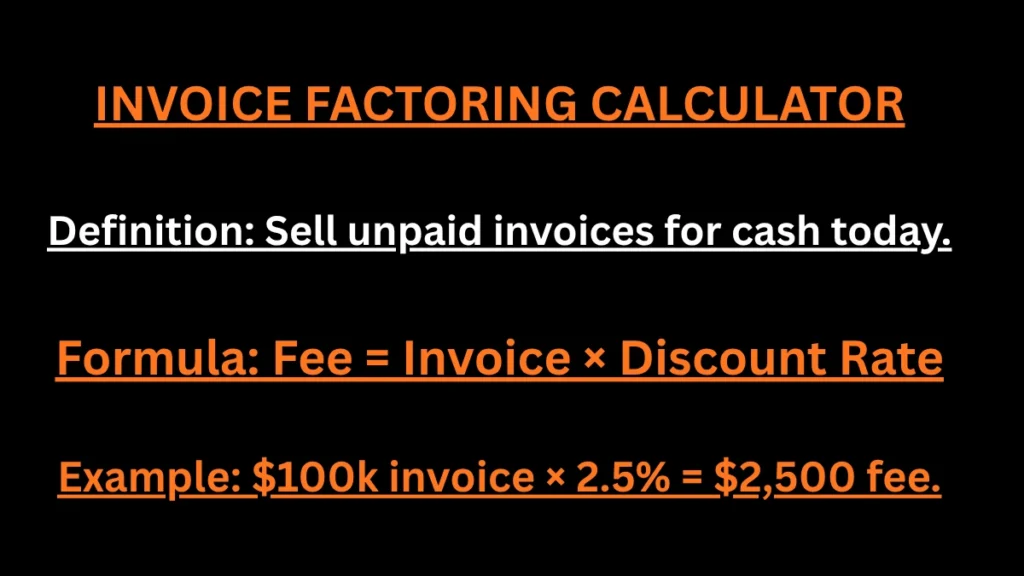
What Is Invoice Factoring?
Let’s start with the basics.
An invoice is a document you send a customer after delivering goods or services. It states what they owe and when payment is due.
Accounts receivable is the total money your customers owe you for invoices that haven’t been paid yet. In simple terms, it’s money you’ve earned but haven’t collected.
Invoice factoring is a financing arrangement where a business sells eligible unpaid invoices to a factoring company (sometimes called a “factor”) at a discount. In exchange, the business receives cash sooner rather than waiting 30, 60, or 90 days for customers to pay.
Here’s how it generally works:
- You complete work and issue an invoice.
- You sell that invoice to a factoring company.
- The factor advances you a percentage of the invoice value upfront.
- The factor collects payment from your customer.
- Once the customer pays, the factor releases the remaining balance, minus applicable fees.
Keep in mind that actual factoring structures vary between providers. Some factors take over collections entirely, while others let you handle customer communication. Some agreements include recourse provisions; others don’t. Always read the contract carefully.
What Is an Accounts Receivable Calculator?
An accounts receivable calculator helps you understand the value of your outstanding invoices and what they might be worth if factored.
You can use it to estimate:
- Total unpaid invoices
- Eligible receivables
- Advance amount
- Reserve
- Factoring fees
- Net proceeds
- Remaining amount after customer payment
For example, let’s say you have $80,000 in outstanding invoices. An accounts receivable calculator can help you see how much of that you might access through factoring, and what it would cost.
How the Invoice Factoring Calculator Works
Most calculators ask for a handful of inputs. Here’s what each one means.
1. Total Invoice Amount
This is the total value of the invoices you’re considering for factoring. If you’re factoring multiple invoices, add them together.
2. Advance Rate
The advance rate is the percentage of the invoice value the factoring company pays you upfront. It’s usually expressed as a percentage.
Advance Amount = Invoice Amount × Advance Rate
For example, if you factor a $50,000 invoice at an 80% advance rate, you’d receive $40,000 upfront.
3. Factoring Fee
The factoring fee is what the factoring company charges for its service. It may be based on the invoice amount, how long the invoice remains outstanding, or another pricing structure.
Don’t assume every provider uses the same fee structure. Some charge a flat percentage; others charge based on days outstanding.
4. Reserve Percentage
The reserve is the portion of the invoice that isn’t advanced immediately. It’s held back until the customer pays.
Reserve = Invoice Amount − Advance Amount
If you factor a $50,000 invoice at an 80% advance rate, the reserve is $10,000.
5. Payment Terms
This is how long your customer typically takes to pay. Payment timing can affect your overall cost depending on the factoring agreement.
What the Calculator Can Estimate
Estimated Advance Amount
This is how much cash you may receive upfront.
Advance = Invoice Amount × Advance Rate
Estimated Reserve
The reserve is the portion not advanced immediately.
Reserve = Invoice Amount − Advance Amount
Estimated Factoring Fee
The factoring fee reduces the amount you ultimately receive. For example, a 2% fee on a $50,000 invoice would be $1,000.
Estimated Net Funding
This is the difference between the initial advance and the amount received after applicable fees. The actual calculation depends on your factoring agreement.
Estimated Total Cost
Look beyond the headline advance rate. The total cost includes factoring fees, reserve effects, and any additional charges.
Invoice Factoring Example
Let’s walk through a hypothetical example using clearly labeled sample figures.
| Item | Sample Amount |
|---|---|
| Invoice amount | $50,000 |
| Advance rate | 80% |
| Reserve | 20% |
| Factoring fee | 2% |
| Customer payment period | 30 days |
Step 1: Initial advance
$50,000 × 80% = $40,000
Step 2: Reserve
$50,000 − $40,000 = $10,000
Step 3: Estimated factoring fee
$50,000 × 2% = $1,000
Step 4: Estimated remaining amount
$10,000 (reserve) − $1,000 (fee) = $9,000
Step 5: Estimated total amount received
$40,000 + $9,000 = $49,000
Step 6: Estimated financing cost
$1,000
This is an illustration only. Actual factoring agreements may use different fee structures, reserve arrangements, and payment terms.
Invoice Factoring vs. Traditional Business Loan
| Feature | Invoice Factoring | Traditional Business Loan |
|---|---|---|
| Funding basis | Accounts receivable | Borrower/business |
| Repayment | Typically connected to invoice collection | Scheduled loan payments |
| Funding purpose | Working capital | Various business purposes |
| Cost structure | Factoring fees and related charges | Interest and loan fees |
| Collateral considerations | Often invoices/receivables | May involve assets or guarantees |
| Approval factors | Receivables and customer quality may matter | Business financial profile may matter |
Neither option is universally better. The right choice depends on your business, your cash flow, and your goals.
Invoice Factoring vs. Invoice Financing
These two terms sound similar, but they work differently.
With invoice factoring, you sell your invoices to a factoring company. The factor typically collects payment from your customer directly.
With invoice financing (sometimes called accounts receivable financing), you borrow money against your invoices but retain control of collections. You repay the lender as your customers pay you.
The key differences:
- Who collects the invoice: In factoring, usually the factor. In financing, usually you.
- How repayment works: Factoring is tied to invoice collection. Financing may involve scheduled repayments.
- How costs differ: Fee structures vary widely between providers and products.
Because providers structure these products differently, always review the specific contract terms.
Who May Consider Invoice Factoring?
Invoice factoring is commonly used by:
- B2B service companies
- Wholesalers
- Distributors
- Manufacturers
- Staffing companies
- Transportation businesses
- Contractors
- Construction companies
- Professional service businesses
Eligibility depends on the provider and the quality and terms of your receivables. Not every business or every invoice will qualify.
When Invoice Factoring May Be Considered
Businesses often look at factoring when:
- Customers have long payment terms
- Working capital is needed
- Payroll is due before customer invoices are paid
- Inventory needs to be purchased
- The business is experiencing rapid growth
- Large invoices are outstanding
- Cash flow timing is creating pressure
Factoring isn’t appropriate for every business. It’s one tool among many, and it works best when you have a clear understanding of your costs and cash flow.
Costs to Consider With Invoice Factoring
Beyond the basic factoring fee, you may encounter:
- Factoring fees
- Discount fees
- Origination fees
- Processing fees
- Wire or transaction fees
- Minimum volume fees
- Early termination fees
- Extension or additional-period fees
Fees vary significantly between providers and agreements. Always ask for a full fee schedule.
Factors That Can Affect Factoring Costs
Several things can influence pricing and availability:
- Invoice amount
- Customer creditworthiness
- Customer payment history
- Payment terms
- Industry
- Invoice age
- Advance rate
- Factoring volume
- Contract length
- Recourse or non-recourse structure
- Number of customers
- Concentration of receivables
If a large portion of your receivables comes from a single customer, for example, a factor may view that as higher risk.
What Is an Advance Rate?
The advance rate is the percentage of the invoice value you receive upfront.
Advance Rate = Initial Advance ÷ Invoice Amount × 100
For example, if you receive $40,000 on a $50,000 invoice, your advance rate is 80%.
What Is a Reserve?
The reserve is the portion of the invoice not advanced immediately.
Reserve = Invoice Amount − Initial Advance
The reserve may be released after the customer pays, minus applicable fees and charges. Actual reserve arrangements vary by provider.
Recourse vs. Non-Recourse Factoring
Recourse Factoring
In recourse factoring, the business may remain responsible if the customer doesn’t pay under the agreement. This typically means the factor can seek repayment from you.
Non-Recourse Factoring
In non-recourse factoring, the factoring provider may assume certain credit risks under specified circumstances. However, “non-recourse” doesn’t necessarily mean every type of non-payment risk is transferred. Disputes, contract issues, and other problems may still fall on you.
Always clarify what’s covered and what isn’t.
Common Mistakes When Using an Invoice Factoring Calculator
Watch out for these pitfalls:
- Looking only at the advance rate
- Ignoring factoring fees
- Forgetting reserve amounts
- Assuming all invoices are eligible
- Ignoring customer payment terms
- Not considering additional fees
- Confusing factoring with a traditional loan
- Assuming the calculator result is the final offer
- Not reading the factoring agreement carefully
Running a few scenarios can help you avoid surprises.
How to Use the Invoice Factoring Calculator
- Enter the total invoice amount.
- Enter the expected advance rate.
- Enter the estimated factoring fee.
- Enter the reserve percentage if required.
- Enter the expected payment period.
- Click Calculate.
- Review the estimated funding and costs.
- Compare the estimate with actual provider terms.
It’s a simple process, but the results are only as good as the numbers you put in.
How Accounts Receivable Affects Cash Flow
There’s an important difference between revenue and cash actually collected.
Revenue is what you’ve earned. Cash collected is what’s actually in your bank account.
Let’s say your company has $100,000 in outstanding invoices. On paper, that’s $100,000 in revenue. But if your customers take 60 days to pay, you might have very little cash available for immediate expenses like payroll or supplier payments.
Monitoring accounts receivable helps you understand your true cash position — not just your sales figures.
Related Calculator Resources
When evaluating cash flow and financing options, you may also need to calculate things like profit margins, break-even points, or loan amortization. The free online calculators at Math Calculator can help with a range of business and financial calculations.
Frequently Asked Questions
1. What is invoice factoring?
Invoice factoring is a financing arrangement where a business sells eligible unpaid invoices to a factoring company at a discount in exchange for faster cash.
2. How does an invoice factoring calculator work?
It takes inputs like invoice amount, advance rate, factoring fee, and payment terms, then estimates your advance, reserve, fees, and net funding.
3. What is an accounts receivable calculator?
It’s a tool that helps you understand the value of your outstanding invoices and what they might be worth if factored.
4. How is the factoring advance calculated?
Advance = Invoice Amount × Advance Rate. For example, $50,000 × 80% = $40,000.
5. What is a factoring reserve?
The reserve is the portion of the invoice not advanced immediately. It’s typically released after the customer pays, minus applicable fees.
6. How are invoice factoring fees calculated?
Fees may be based on the invoice amount, time outstanding, or another structure. They vary by provider.
7. Is invoice factoring the same as a business loan?
No. Factoring involves selling invoices, while a loan involves borrowing money and repaying it on a schedule.
8. Can small businesses use invoice factoring?
Yes, many small businesses use factoring. Eligibility depends on the provider and the quality of your receivables.
9. What is a typical invoice factoring advance rate?
Advance rates vary widely by provider, industry, and transaction. There’s no single “typical” rate. Always confirm with the provider.
10. Are invoice factoring calculator results exact?
No. Calculator results are estimates. Actual contracts and terms can differ.
11. Does invoice factoring affect cash flow?
It can improve short-term cash flow by converting unpaid invoices into available cash sooner.
12. What is the difference between recourse and non-recourse factoring?
In recourse factoring, you may remain responsible if the customer doesn’t pay. In non-recourse factoring, the provider may assume certain credit risks under specified circumstances.
How to Compare Factoring Offers
When comparing offers, review:
- Advance rate
- Factoring fee
- Reserve percentage
- Payment terms
- Additional fees
- Recourse provisions
- Contract length
- Minimum volume requirements
- Termination provisions
- Customer notification requirements
Looking at the total cost is more useful than comparing only one number. A higher advance rate with higher fees may cost more than a lower advance rate with lower fees.
How to Get a More Accurate Estimate
To get a clearer picture, verify these details with the factoring provider:
- Invoice amount
- Eligible receivables
- Advance rate
- Factoring fee
- Reserve
- Customer payment terms
- Additional charges
- Contract conditions
The calculator is an estimate, not a financing offer. Only the provider can give you actual terms.
Conclusion
An Invoice Factoring & Accounts Receivable Calculator can help you estimate how much cash you may receive from outstanding invoices and understand the potential costs of factoring. It’s a useful starting point for understanding your options before you commit to anything.
Just remember to consider the full fee structure, reserve, payment timing, and contract terms before making a financing decision. The headline advance rate is only one part of the picture.
For more free tools to help with related business and financial calculations, visit Math Calculator.