A Merchant Cash Advance Calculator & Cost Estimator helps a business owner turn an MCA offer into numbers they can actually review. Instead of looking at a factor rate and guessing what it means, you can estimate the total payback, the dollar cost of capital, the daily or weekly payment, how long repayment may take, and how the remittance fits into your cash flow. That matters because MCA pricing does not work like a normal loan.
⚡ Merchant Cash Advance Calculator & Cost Estimator
📊 Estimated MCA Summary
ESTIMATE📐 Calculation Steps
What Is a Merchant Cash Advance?
A merchant cash advance is a form of business financing where a provider advances money to a business and the business repays a contracted payback amount, often through a share of future sales or fixed withdrawals. MCA agreements are commonly structured around purchasing future receivables rather than using a conventional loan structure, although legal treatment can vary by jurisdiction and by contract. Some MCAs collect a percentage of daily card sales, while others use fixed daily or weekly ACH debits. Because these structures differ, the way you evaluate cost also differs. A calculator gives you a framework, but the specific agreement determines what you actually owe and when.
What Is an MCA Calculator?
An MCA calculator is an estimation tool. You enter the terms you have been quoted or the terms you are considering, and it produces a set of derived figures. A typical MCA cost calculator works with:
- Advance amount
- Factor rate
- Total payback
- Cost of capital
- Payment frequency
- Repayment term
- Daily or weekly payment
- Fees
- Net amount received
- Cash-flow impact
Not every calculator handles every item, and many online tools simplify heavily. The more inputs a calculator accepts, the more useful it tends to be, because fees and repayment speed are often what separate a manageable obligation from a difficult one.
How Does an MCA Calculator Work?
The calculator moves through the offer in a logical order. First it applies the factor rate to the advance to find total payback. Then it divides that payback by the expected number of payments to estimate the payment amount. If fees are entered, it adjusts the net funding figure. If revenue is entered, it can express the payment as a percentage of revenue.
| Input | Meaning | Effect on Estimate |
|---|---|---|
| Advance amount | The face amount of the funding | Base for all other calculations |
| Factor rate | Multiplier applied to the advance | Determines total payback |
| Term | Expected length of repayment | Affects payment size and annualized cost |
| Payment frequency | Daily, weekly, or other | Affects payment amount and timing |
| Holdback | Percentage of sales remitted | Affects payment variability |
| Fees | Upfront or recurring charges | Reduces net funding and raises effective cost |
| Revenue | Business income used for comparison | Shows payment burden |
Small changes in any of these inputs can shift the result noticeably.
How to Calculate MCA Total Payback
The core formula is simple:
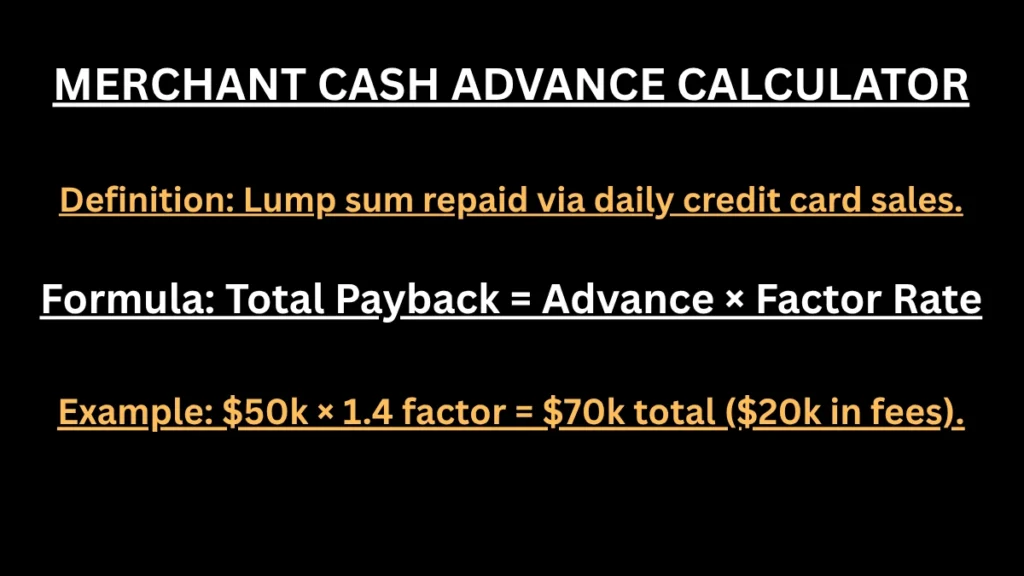
Total Payback = Advance Amount × Factor Rate
A hypothetical illustration:
- Advance = $50,000
- Factor rate = 1.30
- Total payback = $65,000
- Cost of capital = $15,000
The $15,000 is the difference between the advance and the contractual payback in this simplified example. It is not automatically the same as an APR, and it should not be described as one. It is simply the dollar spread between what you receive and what you contract to pay back.
What Is an MCA Factor Rate?
A factor rate is a multiplier. It tells you how much contractual payback is owed for each dollar advanced, under a simplified calculation. Common examples quoted in the market include figures like 1.20, 1.25, 1.30, and 1.40, though actual offers vary widely by provider, industry, revenue profile, and contract structure.
A 1.30 factor means $1.30 of contractual payback for each $1.00 of advance. It is not a 30% APR, and it should not be described that way. The factor rate alone does not tell you the annualized cost of the financing, because that depends on how quickly the payback is collected.
Factor Rate vs APR
This is the part of MCA analysis that causes the most confusion. Factor rate and APR measure different things.
| Factor Rate | APR / Annualized Cost |
|---|---|
| A multiplier applied to the advance | An annualized percentage |
| Fixed at contract signing | Depends on repayment speed |
| Does not account for time | Accounts for time |
| Simple to state | More complex to estimate |
| Same factor can produce different annualized costs | Varies by term, frequency, and fees |
A 1.30 factor repaid over six months produces a very different annualized cost than the same 1.30 factor repaid over twelve months. Fees change the picture further, and so does the timing of payments. Because of this, there is no single universal APR that corresponds to a given factor rate. Any annualized figure is an estimate that depends on the assumptions used.
How to Calculate MCA Cost of Capital
Cost of Capital = Total Payback − Advance Amount
Using the same example:
$65,000 − $50,000 = $15,000
This is the dollar difference in the simplified example. It represents the contractual cost of the advance before considering fees, timing, or the amount actually received. If fees are deducted upfront, the real cost relative to the money you can use is higher than this figure alone suggests.
How MCA Daily Payments Are Calculated
For fixed daily payment structures:
Estimated Daily Payment = Total Payback ÷ Number of Payment Days
A clearly labeled hypothetical example: if total payback is $65,000 and the contract calls for 130 payment days, the estimated daily payment is $500. Actual payment schedules can differ. Some contracts use business days, some use calendar days, and some use a percentage of daily sales rather than a fixed amount.
How MCA Weekly Payments Are Calculated
For weekly remittance:
Estimated Weekly Payment = Total Payback ÷ Number of Weekly Payments
If total payback is $65,000 and the contract calls for 26 weekly payments, the estimated weekly payment is $2,500. The actual number of payments depends on the contract, and some agreements adjust the term based on how quickly sales come in.
What Is an MCA Holdback?
A holdback is the percentage of eligible revenue remitted to the provider. If daily eligible revenue is $5,000 and the holdback is 15%:
$5,000 × 15% = $750
That $750 would be the remittance for that day under a percentage-based structure. Actual MCA structures vary. Some products use fixed ACH payments rather than a percentage of receivables, and not every MCA uses a holdback. The contract determines which structure applies.
MCA Cost Estimator Example
This example is hypothetical and uses internally consistent numbers. It is not an offer or a prediction.
- Advance amount: $50,000
- Factor rate: 1.30
- Total payback: $65,000
- Cost of capital: $15,000
Hypothetical repayment schedules:
| Structure | Calculation | Result |
|---|---|---|
| Daily, 130 payment days | $65,000 ÷ 130 | $500 per day |
| Daily, 260 payment days | $65,000 ÷ 260 | $250 per day |
| Weekly, 26 payments | $65,000 ÷ 26 | $2,500 per week |
| Weekly, 52 payments | $65,000 ÷ 52 | $1,250 per week |
The same total payback produces very different payment sizes and very different annualized costs depending on how long repayment takes. A faster repayment reduces the time you hold the money, which raises the annualized cost. A slower repayment lowers the annualized cost but keeps the obligation on your books longer.
How Fees Affect MCA Cost
Fees can change the effective cost significantly. Common charges include:
- Origination fees
- Underwriting fees
- Processing fees
- ACH fees
- Broker fees where applicable
- Other contract charges
Net Funds Received = Advance Amount − Upfront Fees
An illustration:
- Contractual advance = $50,000
- Fee = $2,500
- Net funds received = $47,500
- Contractual payback = $65,000
In this example, the business receives $47,500 but contracts to pay back $65,000. That difference is larger than the $15,000 cost of capital figure alone suggests. This is why it matters to distinguish between the face advance and the amount actually received.
Net Funding vs Total Payback
| Number | Meaning |
|---|---|
| Advance amount | The face amount stated in the agreement |
| Net amount received | What actually reaches the business after upfront fees |
| Total payback | The contracted amount to be repaid |
These three figures can all be different, and each one matters for a different reason. The advance tells you the scale of the financing. Net funding tells you what you can actually use. Total payback tells you what you owe.
MCA Payment and Business Cash Flow
The payment amount is where an MCA meets reality. A factor rate is abstract. A daily or weekly remittance is not. When reviewing affordability, consider:
- Monthly revenue
- Daily deposits
- Gross margin
- Operating expenses
- Payroll
- Rent
- Inventory
- Existing debt payments
- MCA remittance
A financing cost cannot be evaluated from the factor rate alone. A payment that looks small relative to monthly revenue can still strain cash flow if margins are thin or if revenue is uneven.
MCA Payment as a Percentage of Revenue
Payment Burden = Financing Payment ÷ Revenue × 100
If a weekly payment is $2,500 and weekly revenue is $25,000, the payment burden is 10%. That figure is a starting point, not an answer. Revenue is not the same as profit or available cash. A business with 10% net margins and a 10% payment burden may have very little left over. There is no universal “safe” percentage, because it depends on the business’s cost structure and cash cycle.
MCA Stacking and Multiple Advances
MCA stacking means holding more than one advance at the same time. Each one carries its own daily or weekly remittance, and those obligations add up. A calculator can help you add existing payment obligations when analyzing overall cash flow. Whether stacking is permitted, restricted, or treated as a default under a given agreement depends on the contract, and the terms vary. The practical concern is straightforward: more remittances leave less cash for operations.
MCA Early Payoff
Read the contract carefully before assuming early repayment reduces total cost. Under a standard fixed-factor structure, the contractual payback may not decline simply because the merchant pays faster. In some agreements, paying early reduces the total cost. In others, it does not. Some contracts include prepayment terms, reconciliation provisions, or payoff discounts, and some do not. Actual early-payoff treatment depends entirely on the agreement.
MCA Calculator vs Business Loan Calculator
| Feature | MCA Calculator | Business Loan Calculator |
|---|---|---|
| Pricing method | Factor rate applied to advance | Interest rate applied to balance |
| Payback | Contracted total, often fixed | Amortized over term |
| Interest | Not expressed as interest | Expressed as interest |
| Factor rate | Central input | Not used |
| Repayment structure | Daily, weekly, or percentage-based | Usually monthly |
| Annualized cost | Depends on speed and fees | Calculated from rate and term |
| Payment schedule | Often fixed count of payments | Amortization schedule |
Neither structure is universally better. They answer different questions and suit different situations.
MCA Calculator vs SBA Loan Calculator
Conventional business loans and SBA-backed financing are analyzed differently because they use interest rates and amortization rather than factor rates. If you are comparing options, an SBA loan calculator can help you estimate payments and total interest under that structure. Comparing an MCA estimate with a loan estimate can be informative, but it requires care because the two products price and repay differently. Nothing here is a personalized financing recommendation.
MCA and Working Capital
Working capital is the difference between short-term assets and short-term liabilities. It is worth calculating separately from any financing cost, because a financing product does not fix a working capital problem by itself. A working capital calculator can help you measure that gap. Understanding the size of the gap is useful whether or not you pursue outside funding.
MCA Cost and Business Profitability
Revenue alone should not be used to judge affordability. What matters is what remains after costs. Consider:
- Gross profit
- Operating expenses
- Net operating cash
- Financing payments
- Remaining cash
A business overhead expense calculator can help you total recurring overhead so the comparison is realistic. If the remaining cash after overhead and remittance is thin, the payment burden is worth a second look regardless of what the factor rate suggests.
Merchant Cash Advance vs Invoice Factoring
Both products relate to cash flow, but they work differently. An MCA typically advances funds against future sales or receivables and is repaid through remittances. Invoice factoring typically involves selling specific invoices at a discount and collecting against those invoices. An invoice factoring calculator can help you model that structure if you are comparing approaches. The right comparison depends on what asset or cash flow the financing is tied to.
MCA Cost and Business Debt
An MCA payment is one obligation among many. If the business already carries a commercial mortgage or other long-term debt, those payments compete for the same cash. A commercial mortgage calculator can help you review those payments when planning overall cash flow. Total debt service is what matters, not any single payment in isolation.
If the business also carries equipment obligations, a business equipment lease calculator can help you estimate those payments and include them in the same picture. And if you want to see how business debt and assets fit into the owner’s broader financial position, a net worth calculator can help organize that view.
MCA Calculator Inputs Checklist
| Input | Where to Find It | Why It Matters |
|---|---|---|
| Advance amount | Contract or offer | Base of the calculation |
| Factor rate | Contract or offer | Determines total payback |
| Total payback | Contract | The amount contracted to repay |
| Payment amount | Contract | Affects weekly or daily cash flow |
| Payment frequency | Contract | Daily versus weekly changes impact |
| Term | Contract | Affects annualized cost |
| Fees | Contract | Reduces net funding |
| Net funding | Advance minus fees | What you can actually use |
| Revenue | Business records | Used for payment burden comparison |
| Existing financing payments | Loan statements | Adds to total obligations |
Common MCA Calculation Mistakes
- Treating factor rate as APR
- Ignoring repayment speed
- Ignoring fees
- Using gross revenue as profit
- Forgetting existing debt
- Ignoring payment frequency
- Confusing advance amount with net funding
- Assuming early payoff reduces cost
- Ignoring cash-flow fluctuations
- Comparing only the factor rate
Each of these can make an offer look cheaper or more manageable than it is.
How to Read an MCA Contract Before Using a Calculator
Before entering numbers into any MCA calculator, find them in the actual agreement. Look for:
- Purchased amount or total payback
- Advance amount
- Factor rate
- Daily or weekly remittance
- Payment frequency
- Fees
- Default provisions
- Early payoff terms
- Reconciliation provisions where applicable
Use the contract figures rather than generic online examples. Online examples illustrate how the math works. The contract controls what you owe.
MCA Cost Estimator Example With Fees
This second example is hypothetical.
- Advance amount: $50,000
- Factor rate: 1.30
- Gross payback: $65,000
- Cost of capital: $15,000
- Origination fee: $2,500
- Net funds received: $47,500
- Payment frequency: Daily
- Payment days: 130
- Estimated daily payment: $500
- Estimated term: approximately 130 business days
If you compare the $15,000 cost of capital to the $47,500 actually received, the effective cost is higher than the spread against the $50,000 face amount suggests. That distinction matters when comparing offers.
Frequently Asked Questions
1. What is a merchant cash advance calculator?
It is a tool that estimates total payback, cost of capital, payment amounts, and repayment timing based on the terms you enter.
2. How do you calculate MCA payback?
Multiply the advance amount by the factor rate. A $50,000 advance at 1.30 produces a $65,000 contractual payback.
3. What is a factor rate?
A multiplier applied to the advance to determine contractual payback. A 1.30 factor means $1.30 owed per $1.00 advanced, under a simplified calculation.
4. Is a factor rate the same as APR?
No. A factor rate is a multiplier, while APR is an annualized percentage. The same factor can produce different annualized costs depending on repayment speed and fees.
**5. How much does a $50,000 MCA cost at a 1.30 factor?**
In the simplified example, total payback is $65,000 and the dollar cost of capital is $15,000. Fees and repayment speed would change the effective cost.
6. How is an MCA daily payment calculated?
Divide total payback by the number of payment days. $65,000 over 130 days is $500 per day.
7. What is an MCA holdback?
A percentage of eligible revenue remitted to the provider. If daily revenue is $5,000 and the holdback is 15%, the remittance is $750 that day.
8. Do MCA fees affect the true cost?
Yes. Fees reduce the net amount received, which raises the effective cost relative to the money you can actually use.
9. Does paying an MCA early reduce the total payback?
It depends on the contract. Some agreements offer a discount or reconciliation, and others do not.
10. What is MCA stacking?
Holding more than one advance at the same time. Each remittance adds to the total cash-flow burden.
11. How can I compare an MCA with a business loan?
Convert each option into comparable measures such as total cost, payment amount, and payment burden. The structures differ, so the comparison requires care.
12. Can an MCA calculator calculate the exact cost of an offer?
No. It produces estimates. The contract controls the actual terms.
13. What information do I need to use an MCA calculator?
Advance amount, factor rate, term, payment frequency, fees, revenue, and any existing financing payments.
14. Why does repayment speed matter?
It affects the annualized cost. The faster the payback, the higher the annualized cost for the same factor rate.
15. Does an MCA payment affect business cash flow?
Yes. Daily or weekly remittances reduce available cash, and the impact depends on margins and revenue consistency.
Final Thoughts on Merchant Cash Advance Calculator & Cost Estimator
A Merchant Cash Advance Calculator & Cost Estimator helps you organize the numbers behind an offer: advance amount, factor rate, total payback, cost of capital, fees, payment amount, repayment period, and cash-flow impact. It also helps you estimate annualized cost, provided you remember that such an estimate depends on repayment speed, payment frequency, fees, and the amount actually received. The calculator is an estimation tool. Actual contract terms control, and those terms vary by provider and structure. Use the numbers to ask better questions, compare offers carefully, and review the agreement in full before making a decision.