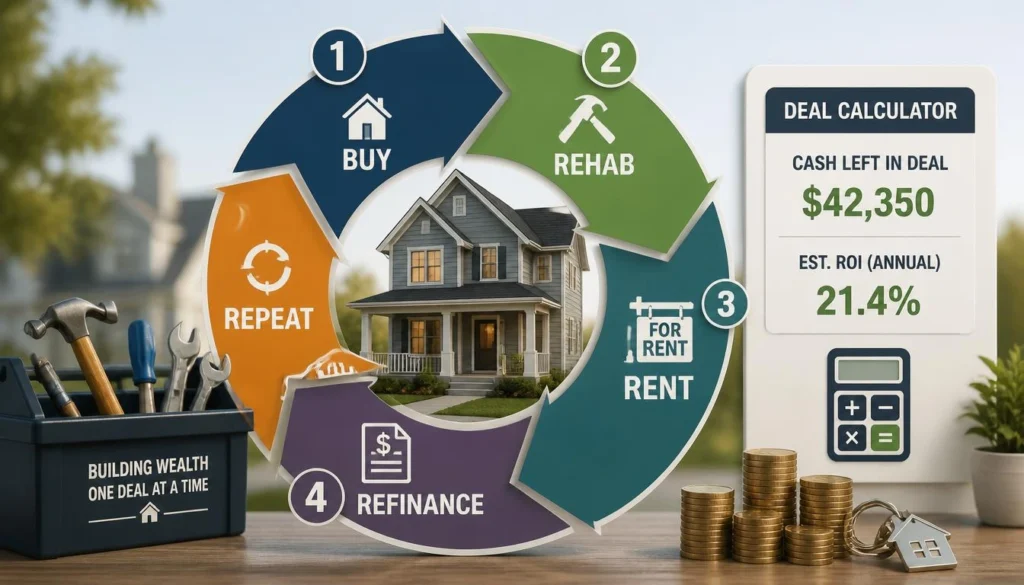
A Free BRRRR Calculator for Real Estate Investors helps you organize the numbers behind a buy, rehab, rent, refinance, repeat strategy before you commit money to a property. BRRRR stands for Buy, Rehab, Rent, Refinance, and Repeat. You buy a property, often one that needs work, renovate it, rent it out, refinance it to pull some cash back out, and then use that capital toward another property.
Free BRRRR Calculator for Real Estate Investors
Estimate your BRRRR project cost, refinance, cash flow, and returns.
Buy & Rehab
Financing the Purchase
After Repair Value
Refinance
Rental Property
BRRRR Results
Calculation
What Is the BRRRR Strategy?
The BRRRR method is a five-step approach to building a rental portfolio. Each step depends on the one before it.
| Step | What It Means |
|---|---|
| Buy | Purchase a property, often below market value and frequently one that needs repairs |
| Rehab | Renovate the property to improve its condition, rentability, and value |
| Rent | Place a tenant and begin collecting rental income |
| Refinance | Replace the original financing with a new loan, often based on the property’s appraised value |
| Repeat | Use recovered capital toward another property |
The key difference between BRRRR and flipping is the end goal. A flip is usually sold after renovation to produce a profit. A BRRRR property is generally kept as a rental after rehab, with the refinance used to recover capital rather than a sale used to exit. That means the property still carries debt and ongoing expenses after the refinance, and it still has to perform as a rental.
What Is a BRRRR Calculator?
A BRRRR calculator is a deal-analysis tool that estimates the financial shape of a BRRRR project from purchase through refinance. It typically pulls together:
- Purchase price
- Rehab budget
- Closing costs
- Holding costs
- After-repair value (ARV)
- Refinance loan-to-value (LTV)
- Refinance costs
- New loan amount
- Cash returned at refinance
- Cash left in the deal
- Equity remaining
- Rental cash flow after refinance
A BRRRR investment calculator is not a crystal ball. It cannot tell you what an appraiser will conclude, what a lender will approve, or what a tenant will pay. It simply shows you what your assumptions produce when you run them through the math. That makes it easier to compare deals and to see which assumptions are doing the most work.
How a BRRRR Calculator Works
The calculator moves through the deal in order: acquisition, rehab, holding period, refinance, and then rental operation. Here are the main inputs and why they matter.
| Input | Meaning | Why It Matters |
|---|---|---|
| Purchase price | What you pay for the property | Sets the base for closing costs and total cost |
| Rehab cost | What you expect to spend on renovations | Often the largest variable and the most commonly underestimated |
| Closing costs | Fees paid at purchase | Adds to the cash you need upfront |
| Holding costs | Taxes, insurance, utilities, and loan payments during the project | Accumulate for every month the property is not rented |
| After-repair value | The property’s estimated value once renovations are complete | Drives the refinance amount |
| Refinance LTV | The percentage of value a lender will lend against | Determines the new loan size |
| Refinance closing costs | Fees paid at refinance | Reduce the cash you actually recover |
| Monthly rent | Expected rent after the property is stabilized | Supports cash flow and lender underwriting |
| Operating expenses | Taxes, insurance, maintenance, management, vacancy | Reduce net income |
| Interest rate | Rate on the new refinance loan | Affects the monthly payment |
| Loan term | Length of the refinance loan | Affects the monthly payment and total interest |
Each input feeds into the next stage of the calculation. Change one and the downstream results change too.
BRRRR Calculator Formula
The math behind a BRRRR deal is not complicated, but the order matters. Here are the core formulas.
Total Cost = Purchase Price + Rehab Costs + Acquisition/Closing Costs + Holding Costs
This is the all-in cost of getting the property renovated and ready to rent. It represents the money you have committed before any refinance happens.
Maximum Refinance Loan = ARV × Refinance LTV
If the property appraises at your estimated ARV and the lender allows that LTV, this is the loan size you might expect.
Net Refinance Proceeds = Refinance Loan − Refinance Closing Costs − Existing Loan Payoff
This is the cash that actually reaches you after the old loan is paid off and refinance fees are deducted.
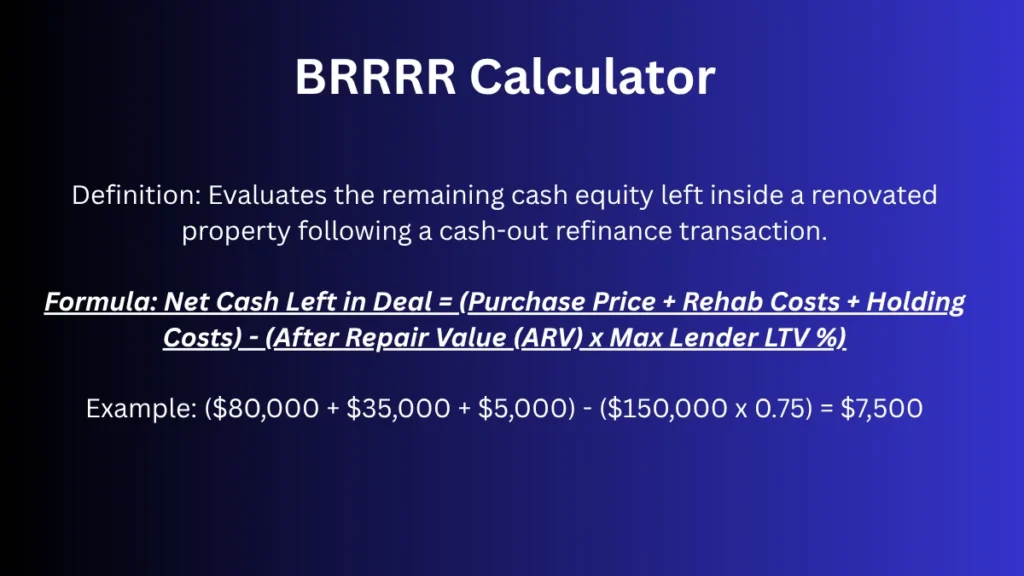
Cash Left in Deal = Total Cash Invested − Net Cash Recovered
This shows how much of your original money is still tied up in the property after the refinance.
Equity After Refinance = ARV − New Loan Balance
This is the portion of the property you own outright, based on the estimated value and the new loan.
The exact result can vary depending on how acquisition financing, existing debt, holding costs, and refinance expenses are treated. Two investors can run the same property and get different numbers if they handle those items differently. That is normal.
What Is After-Repair Value (ARV)?
After-repair value, usually shortened to ARV, is the estimated value of a property once the planned renovations are complete. It is the number that drives the refinance, so it deserves careful attention.
ARV should be based on realistic comparable sales, current market evidence, and the actual condition the property will be in when the work is finished. It should not be based on the best-case number that makes the deal work. If you want a structured way to review value, a property valuation calculator can help you work through the estimate.
An optimistic ARV is one of the most common reasons a BRRRR projection looks better on paper than it turns out in practice. If the appraisal comes in lower than expected, the refinance loan shrinks and more of your cash stays in the deal.
How Much Cash Can You Recover With a BRRRR Refinance?
The amount you can recover depends mainly on two things: the appraised value and the refinance LTV the lender allows. A simple illustration:
- ARV = $200,000
- Refinance LTV = 75%
- Potential new loan = $150,000
That is only a mathematical illustration. Actual lender limits, appraisal results, credit requirements, loan terms, and property condition can all change the amount available. A 75% LTV is a common example, not a universal lender requirement. Some lenders allow more, some allow less, and some property types or borrower profiles may not qualify at all.
Cash Left in the Deal Explained
“Cash left in the deal” is the amount of your own money still tied up in the property after the refinance. There are three general outcomes:
- Most of the original cash is recovered.
- Some cash remains invested in the property.
- More cash is recovered than was initially invested.
Recovering cash does not automatically mean the property is profitable. After a refinance, the property still carries debt, operating costs, vacancy risk, maintenance, and other expenses. Recovering capital improves liquidity, but it does not remove risk.
BRRRR Rental Cash Flow After Refinancing
A BRRRR deal should be analyzed after the refinance, not just at purchase. The new loan changes the debt service, and the property now has to support that payment along with its operating costs.
Monthly Cash Flow = Monthly Rental Income − Monthly Operating Expenses − Monthly Debt Payment
Operating expenses typically include vacancy allowance, property taxes, insurance, maintenance, property management, utilities paid by the owner, and any HOA dues. The result is an estimate. A property that cash flows before refinancing may not cash flow after, because the new loan is often larger than the original one.
BRRRR vs Traditional Buy-and-Hold
| Feature | BRRRR | Traditional Buy-and-Hold |
|---|---|---|
| Acquisition | Often below market, frequently distressed | Often retail or near retail |
| Rehabilitation | Central to the strategy | Sometimes minor, sometimes none |
| Refinancing | Usually part of the plan | Optional |
| Capital recovery | A main objective | Not typically a focus |
| Rental operation | Long-term rental after rehab | Long-term rental from purchase |
| Complexity | Higher, with more moving parts | Lower, with fewer stages |
| Financing considerations | Short-term acquisition debt plus long-term refinance | Typically one long-term loan |
Neither approach is universally better. BRRRR involves more execution risk because it depends on rehab, appraisal, and refinance outcomes lining up. Traditional buy-and-hold is simpler but usually requires more capital to stay invested.
BRRRR Calculator vs Rental Property Calculator
The two tools overlap, but they answer different questions.
A BRRRR calculator focuses on acquisition, rehab, ARV, refinance, and capital recovery. Its main job is to estimate how much cash comes back and how much stays in the deal.
A rental property calculator usually focuses more on rent, expenses, financing, cash flow, and rental returns. Its main job is to estimate ongoing performance.
Used together, they give a fuller picture. One tells you what it takes to get into and through the project. The other tells you what the property looks like once it is running.
Financing a BRRRR Property
BRRRR projects often involve more than one type of financing. Common options include:
- Cash purchase
- Conventional financing
- Hard-money financing
- Bridge financing
- Refinance financing
- DSCR financing
Terms vary between lenders and properties, and not every property or borrower qualifies for every option. Lenders may review debt-service coverage when evaluating a rental property loan, and a DSCR calculator can help you estimate the relationship between net operating income and debt service. When financing is measured against the total project cost rather than the property’s value, a loan-to-cost calculator can be useful.
BRRRR Refinance and Mortgage Payments
The refinance loan is what the property has to carry going forward. Its size, interest rate, and term determine the monthly payment.
- A larger loan means a larger payment.
- A higher interest rate increases the payment.
- A longer term lowers the monthly payment but increases total interest.
To estimate the payment on the new loan, a mortgage payment calculator can help you review both the monthly figure and the payment schedule. Small changes in rate or term can shift cash flow meaningfully.
Cap Rate and BRRRR Analysis
Cap rate offers another way to review a rental property’s operating performance, separate from financing.
Cap Rate = Net Operating Income ÷ Property Value × 100
Net operating income is rental income minus operating expenses, before debt payments. Cap rate is useful for comparing properties, but it does not account for how the deal is financed. If you want to calculate it directly, a cap rate calculator can do that. Cap rate alone does not determine whether a BRRRR deal works.
BRRRR Example Calculation
This example is hypothetical and uses internally consistent numbers. It is not a prediction.
Acquisition and rehab:
- Purchase price: $150,000
- Rehab cost: $30,000
- Closing costs: $4,000
- Holding costs: $6,000
- Total cash invested: $190,000
Refinance:
- ARV: $240,000
- Refinance LTV: 75%
- New loan amount: $180,000
- Refinance closing costs: $4,000
- Existing loan payoff: $0 (assumes cash purchase)
- Net cash returned: $180,000 − $4,000 = $176,000
Result:
- Cash left in deal: $190,000 − $176,000 = $14,000
- Remaining equity: $240,000 − $180,000 = $60,000
Post-refinance cash flow estimate:
- Monthly rent: $1,900
- Monthly operating expenses: $760
- Monthly debt payment on $180,000 at 6.5% over 30 years: approximately $1,138
- Estimated monthly cash flow: $1,900 − $760 − $1,138 = $2
In this illustration, the investor recovers most of the original capital but the property barely cash flows. A slightly higher rate, a lower rent, or a larger vacancy allowance would push it negative. That is the kind of sensitivity a BRRRR deal analyzer is meant to expose.
How to Analyze a BRRRR Deal Step by Step
- Estimate the purchase price.
- Estimate the full rehab budget.
- Add acquisition and holding costs.
- Estimate realistic ARV.
- Estimate achievable rent.
- Estimate operating expenses.
- Estimate the refinance amount.
- Calculate net cash recovery.
- Calculate cash left in the deal.
- Review post-refinance cash flow.
- Stress-test the assumptions.
- Compare the results with actual lender and property information.
Steps 11 and 12 are the ones investors skip most often. Running the numbers at a higher interest rate, lower rent, or higher rehab cost shows how fragile the deal might be.
Common BRRRR Calculator Mistakes
- Overestimating ARV
- Underestimating rehab costs
- Forgetting closing costs
- Ignoring holding costs
- Assuming full occupancy
- Ignoring property management
- Underestimating maintenance
- Ignoring refinance costs
- Assuming a specific LTV is guaranteed
- Forgetting the existing loan payoff
- Ignoring interest-rate changes
- Assuming the appraisal will match the estimated ARV
- Treating projected appreciation as guaranteed
- Failing to keep emergency reserves
Any one of these can turn a projected recovery into a shortfall.
BRRRR Risk Factors
BRRRR carries several distinct risks:
- Construction risk
- Budget overruns
- Appraisal risk
- Refinance risk
- Interest-rate risk
- Vacancy risk
- Rental demand risk
- Property condition risk
- Financing risk
- Market risk
These risks do not disappear because the calculator shows a favorable result. They are the reasons the result is an estimate and not a guarantee.
BRRRR Calculator and the 70% Rule
The 70% rule is a rule of thumb some investors use: pay no more than 70% of ARV minus rehab costs. It is a shortcut, not a requirement.
Actual deal analysis should account for rehab, closing costs, holding costs, financing costs, refinance costs, and market conditions. The 70% rule ignores most of those, which is why it works better as a first filter than as a final answer.
BRRRR and Equity
Estimated Equity = ARV − New Loan Balance
Equity is the portion of the property you own based on its value and the debt against it. Equity is not the same as cash. You cannot spend equity directly. Accessing it usually requires another refinance, a sale, or a line of credit, each with its own costs and requirements.
BRRRR and Cash-on-Cash Return
Cash-on-cash return can look unusual in a BRRRR deal because the refinance may return most of the investor’s original capital. When the denominator shrinks, the percentage can become very large or mathematically undefined.
That does not make the return automatically meaningful. Investors should also examine actual cash flow, debt, equity, reserves, and risk. A high percentage on a small remaining investment can still represent a small amount of money.
BRRRR Investment Strategies
Many investors use recovered capital to fund another property, which is the “repeat” part of the strategy. The idea is to recycle capital rather than leave it locked in one property. A BRRRR calculator can help you run those scenarios before committing to a project. Recovered capital is not free money. It comes with a larger loan and a larger payment on the property that produced it.
BRRRR and Personal Financial Position
Rental property equity and debt sit alongside your other assets and liabilities. Seeing them together can clarify how a BRRRR project affects your broader position. A net worth calculator can help you list those items, though it is not a substitute for financial advice.
BRRRR Calculator Inputs Checklist
| Input | Example Type | Why It Matters |
|---|---|---|
| Purchase price | Dollar amount | Base cost of the deal |
| Rehab budget | Dollar amount | Largest variable in most projects |
| Closing costs | Dollar amount | Upfront cash requirement |
| Holding costs | Monthly amount | Accumulates during the project |
| ARV | Dollar amount | Drives refinance size |
| Refinance LTV | Percentage | Determines new loan |
| Refinance costs | Dollar amount | Reduces cash recovered |
| Monthly rent | Dollar amount | Supports cash flow |
| Vacancy rate | Percentage | Reduces effective income |
| Operating expenses | Monthly amount | Reduces net income |
| Interest rate | Percentage | Affects refinance payment |
| Loan term | Years | Affects payment and total interest |
Who Can Use a BRRRR Calculator?
- New real estate investors learning deal analysis
- Experienced rental investors comparing projects
- Landlords evaluating whether to renovate and refinance
- Investors comparing potential rental properties
- Investors analyzing refinance scenarios
A calculator supports your thinking. It does not replace professional advice from lenders, accountants, attorneys, or appraisers.
Frequently Asked Questions About BRRRR Calculators
1. What does BRRRR stand for?
Buy, Rehab, Rent, Refinance, Repeat. It describes a five-step process for acquiring and holding rental properties while recovering capital through refinancing.
2. What is a BRRRR calculator?
It is a tool that estimates the costs, refinance proceeds, cash left in the deal, equity, and rental cash flow of a BRRRR project based on the assumptions you enter.
3. How does a BRRRR calculator work?
It adds up purchase, rehab, closing, and holding costs, applies an LTV to the estimated ARV, subtracts refinance costs and any existing loan payoff, and then compares recovered cash to cash invested.
4. What is ARV in a BRRRR deal?
After-repair value is the estimated value of the property once renovations are complete. It drives the refinance amount and should be based on realistic comparable sales.
5. How do you calculate cash left in a BRRRR deal?
Total cash invested minus net cash recovered at refinance. The result is the amount of your own money still in the property.
6. How much can you refinance from a BRRRR property?
It depends on the appraised value, the lender’s LTV limit, your qualifications, and the property type. There is no single answer that applies to every deal.
7. What costs should be included in BRRRR calculations?
Purchase price, rehab, closing costs, holding costs, refinance costs, operating expenses, and debt service. Missing any of them distorts the result.
8. Does rehab cost affect BRRRR ROI?
Yes. Rehab is usually the largest controllable cost, and overruns directly increase the cash left in the deal.
9. Does rent matter when analyzing a BRRRR property?
Yes. Rent supports cash flow and lender underwriting. A property that recovers capital but does not rent well is still a weak investment.
10. What happens if the property appraises below the estimated ARV?
The refinance loan shrinks, less cash is recovered, and more of your money stays in the deal. This is one of the most common BRRRR shortfalls.
11. Can a BRRRR deal have positive cash flow but still require cash?
Yes. Cash flow and capital recovery are separate. A property can cash flow while still leaving a meaningful amount of your original capital invested.
12. Is the 70% rule required for every BRRRR deal?
No. It is a rule of thumb some investors use as a first filter. It does not account for holding costs, financing costs, or refinance costs.
13. How accurate is a BRRRR calculator?
It is only as accurate as your inputs. Rehab estimates, ARV, rent, and lender terms all carry uncertainty.
14. What risks should investors consider before using a BRRRR strategy?
Construction overruns, appraisal shortfalls, refinance denial, interest-rate changes, vacancy, maintenance, and market shifts. Any of these can change the outcome.
The information in this article is provided for general educational and informational purposes only. It is not financial, investment, tax, legal, or accounting advice, and it should not be treated as a substitute for professional guidance from a qualified advisor who understands your specific situation.