Determining the value of a commercial property is one of the most critical steps for any investor, owner, or buyer. Unlike residential real estate, where value is often driven by emotion and comparable sales, commercial property value is rooted in the income it produces. A Commercial Property Valuation Calculator is a practical tool that helps you estimate that value quickly by using key financial metrics like net operating income and capitalization rates.
Property Valuation Results
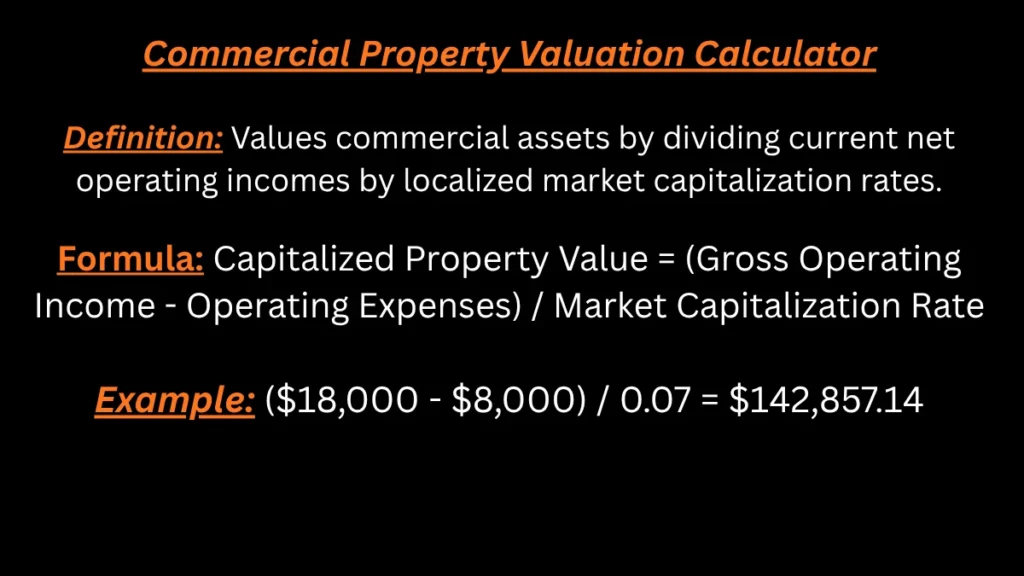
Commercial Property Valuation Calculator: Estimate Commercial Real Estate Value
This guide explains how these calculators work, the formulas behind them, and how to use them correctly. You will learn what inputs are required, how to interpret the results, and why an online estimate is a starting point—not a substitute for a professional appraisal. Whether you are evaluating a potential purchase or reviewing your current portfolio, understanding the math behind the value is essential.
What Is a Commercial Property Valuation Calculator?
A Commercial Property Valuation Calculator is an online tool that estimates the market value of an income-producing property. It takes financial data you provide—such as rental income, operating expenses, and a capitalization rate—and applies a standard valuation formula to produce a dollar estimate.
This tool is designed for a wide range of users:
- Investors screening potential deals
- Property owners curious about their asset’s current value
- Buyers preparing an offer
- Real estate agents conducting a preliminary analysis
- Landlords reviewing portfolio performance
People use these calculators because they offer a fast, low-cost way to get a ballpark figure. A formal appraisal can be expensive and time-consuming. A calculator gives you a directional estimate in seconds, helping you decide whether a deeper analysis is worth pursuing.
How Does a Commercial Property Valuation Calculator Work?
Most commercial property value calculators rely on the income approach, which values a property based on the income it generates. The process is straightforward:
- You input the property’s income. This includes annual rent and any other income (like parking fees or vending machines).
- You input the operating expenses. These are the costs required to run the property, such as maintenance, insurance, and property taxes.
- The calculator determines Net Operating Income (NOI). It subtracts operating expenses from income.
- You provide a capitalization rate (cap rate). This is a market-derived percentage that reflects the risk and return expectations for similar properties.
- The calculator divides NOI by the cap rate. The result is the estimated property value.
Some advanced calculators may ask for vacancy rates or growth assumptions, but the core logic remains the same. The accuracy of the output depends entirely on the accuracy of your inputs.
[Internal link opportunity: Net Operating Income Calculator]
Commercial Property Valuation Formula
The most common formula for valuing income-producing commercial property is:
Property Value = Net Operating Income ÷ Capitalization Rate
To use this formula, the cap rate must be entered as a decimal. For example, an 8% cap rate is entered as 0.08, not 8.
Here is what each term means:
- Property Value: The estimated market value of the property.
- Net Operating Income (NOI): The property’s annual income after operating expenses, but before mortgage payments and income taxes.
- Capitalization Rate (Cap Rate): A percentage that represents the expected rate of return on the property.
Example:
- NOI = $100,000
- Cap rate = 8% (0.08)
Estimated Value = $100,000 ÷ 0.08 = $1,250,000
This formula is the backbone of commercial real estate valuation. It is used by appraisers, investors, and lenders worldwide. However, it is not the only method. The sales comparison and cost approaches can also be relevant, depending on the property type and available data.
How to Use a Commercial Property Valuation Calculator
Using a calculator is simple, but you need to gather the right information first. Here are the typical inputs:
- Annual Rental Income: The total rent you expect to collect in a year. Use current leases or market rent if the property is vacant.
- Other Property Income: Income from parking, signage, laundry, or other sources.
- Vacancy and Credit Losses: An estimate of income lost due to empty units or non-paying tenants. This is often expressed as a percentage of gross income.
- Operating Expenses: Costs like property management, maintenance, insurance, property taxes, utilities paid by the owner, and repairs.
- Net Operating Income (NOI): Some calculators ask you to input NOI directly. If not, they calculate it for you.
- Cap Rate: The capitalization rate for similar properties in your market.
- Property Type: Some tools adjust default cap rates based on whether the property is office, retail, industrial, or multifamily. Do not assume every calculator uses every input. Check the tool’s instructions.
What Is Net Operating Income (NOI)?
Net operating income (NOI) is the property’s income after normal operating expenses, but before mortgage payments and income taxes. It is a measure of the property’s profitability from operations alone.
NOI = Total Income – Operating Expenses
Operating expenses typically include:
- Property management fees
- Maintenance and repairs
- Insurance
- Property taxes
- Utilities paid by the owner
- Advertising and leasing costs
- Janitorial services
- HOA fees (if applicable)
What is excluded from NOI?
- Mortgage principal and interest payments
- Income taxes
- Capital expenditures (major improvements)
- Depreciation
Mortgage payments are excluded because NOI measures the property’s performance independent of how it is financed. This allows investors to compare properties on an equal footing.
[Internal link opportunity: Cap Rate Calculator]
What Is a Capitalization Rate?
The capitalization rate, or cap rate, is a percentage that reflects the expected return on a commercial property. It is calculated as:
Cap Rate = NOI ÷ Property Value
Cap rates are determined by the market. They vary based on location, property type, tenant quality, and market conditions. A lower cap rate generally means lower risk and lower return potential. A higher cap rate suggests higher risk and higher return potential.
How Cap Rate Affects Value:
A small change in the cap rate can significantly change the estimated value. For example, a property with a $100,000 NOI is worth $1,250,000 at an 8% cap rate. At a 7% cap rate, the same NOI produces a value of $1,428,571. At a 9% cap rate, the value drops to $1,111,111.
Two similar properties can have different cap rates because of differences in lease terms, tenant creditworthiness, building age, and local demand. There is no universally “good” or “bad” cap rate. It depends on the market and the investor’s goals.
Commercial Property Valuation Example
Here are three numerical examples to illustrate how the formula works.
Example 1: Basic Valuation
- Annual rental income: $150,000
- Other income: $10,000
- Operating expenses: $40,000
- NOI: $150,000 + $10,000 – $40,000 = $120,000
- Cap rate: 7.5% (0.075)
- Estimated value: $120,000 ÷ 0.075 = $1,600,000
Example 2: Changing the Cap Rate
Using the same NOI of $120,000:
- At a 6% cap rate: $120,000 ÷ 0.06 = $2,000,000
- At an 8% cap rate: $120,000 ÷ 0.08 = $1,500,000
- At a 10% cap rate: $120,000 ÷ 0.10 = $1,200,000
This shows how sensitive commercial property value is to the cap rate.
Example 3: Changing the NOI
Assume a cap rate of 8% (0.08):
- NOI of $80,000: $80,000 ÷ 0.08 = $1,000,000
- NOI of $100,000: $100,000 ÷ 0.08 = $1,250,000
- NOI of $120,000: $120,000 ÷ 0.08 = $1,500,000
A higher NOI directly increases the estimated value.
Factors That Affect Commercial Property Value
Several factors influence the value of a commercial property. Some are within the owner’s control; others are market-driven.
- Location: A prime location with high foot traffic or easy access can command a higher value.
- Property Type: Office, retail, industrial, and multifamily properties have different risk profiles and cap rates.
- Rental Income: Higher rent increases NOI and value.
- Occupancy: High vacancy reduces income and increases risk.
- Lease Terms: Long-term leases with creditworthy tenants are more valuable than short-term leases.
- Tenant Quality: A national tenant may be seen as lower risk than a local startup.
- Operating Expenses: Lower expenses increase NOI.
- NOI: The primary driver of value in the income approach.
- Cap Rate: Market sentiment and interest rates influence cap rates.
- Property Condition: A well-maintained building attracts tenants and buyers.
- Building Age: Older buildings may have higher maintenance costs.
- Market Conditions: Supply and demand, interest rates, and economic trends all play a role.
- Comparable Sales: Recent sales of similar properties provide market evidence.
- Remaining Lease Terms: Longer lease terms can add stability and value.
Income Approach vs. Sales Comparison Approach
There are three main approaches to commercial property valuation:
| Approach | How It Works | Best Used For |
|---|---|---|
| Income Approach | Values property based on the income it generates. Uses NOI and cap rate. | Income-producing properties like offices, retail, and apartments. |
| Sales Comparison Approach | Compares the property to similar properties that have recently sold. | Properties with frequent sales, like small retail or multifamily. |
| Cost Approach | Estimates the cost to rebuild the property, minus depreciation. | Special-purpose properties like schools, churches, or stadiums. |
The income approach is the most common for commercial real estate because it directly ties value to financial performance. The sales comparison approach is useful when reliable comparable sales exist. The cost approach is rarely used for standard investment properties but can be helpful for unique buildings.
Commercial Property Valuation vs. Residential Property Valuation
Commercial and residential valuations differ in several key ways:
- Income Generation: Commercial properties are valued primarily on income. Residential properties are often valued on comparable sales.
- Tenant Leases: Commercial leases are typically longer and more complex. Residential leases are usually shorter and simpler.
- NOI: Commercial valuation relies heavily on NOI. Residential valuation does not.
- Cap Rates: Cap rates are central to commercial valuation. They are rarely used in residential valuation.
- Operating Expenses: Commercial owners often pay more expenses (like taxes, insurance, and maintenance). Residential tenants often pay their own utilities.
- Comparable Properties: Commercial comparables are harder to find because properties are unique. Residential comparables are more standardized.
- Valuation Complexity: Commercial valuation is generally more complex due to lease structures, tenant quality, and market dynamics.
How Accurate Is a Commercial Property Valuation Calculator?
An online calculator provides an estimate, not a formal appraisal. Its accuracy depends on the quality of your inputs and the assumptions built into the tool.
Factors that can affect accuracy include:
- Incorrect income figures
- Incorrect expenses
- Using the wrong cap rate
- Unrealistic vacancy assumptions
- Rapid market changes
- Property-specific conditions
- Incomplete information
A calculator is a screening tool. It helps you decide whether a property is worth a deeper look. For a legally binding valuation, you need a professional appraiser.
Common Commercial Property Valuation Mistakes
Avoid these common errors when using a calculator:
- Using gross rent instead of NOI: Gross rent does not account for expenses. Always use NOI.
- Forgetting operating expenses: Missing expenses inflates NOI and value.
- Using the wrong cap rate: Cap rates vary by market and property type. Use a rate that reflects your property.
- Ignoring vacancy: Vacancy reduces income. Always include a vacancy allowance.
- Mixing mortgage costs into NOI: Mortgage payments are not operating expenses. Exclude them from NOI.
- Using outdated market assumptions: Cap rates and market conditions change. Use current data.
- Comparing very different properties: A retail strip center is not comparable to an office tower.
- Relying on one valuation method only: Use multiple methods to cross-check your estimate.
How to Improve a Commercial Property Value Estimate
To get a more reliable estimate:
- Use accurate income data from leases and rent rolls.
- Review actual operating expenses from financial statements.
- Use relevant market cap rates from recent sales.
- Check comparable properties in the same market.
- Review occupancy history and current lease terms.
- Consider tenant quality and lease duration.
- Update your assumptions regularly.
These steps improve the quality of your estimate. They do not guarantee an exact market value.
When Should You Use a Commercial Property Valuation Calculator?
Use a calculator in these situations:
- Buying commercial property: To screen potential deals.
- Selling commercial property: To set a realistic asking price.
- Reviewing an investment: To assess performance.
- Comparing properties: To rank opportunities.
- Refinancing preparation: To estimate value before applying for a loan.
- Portfolio analysis: To track value across multiple properties.
- Estimating investment returns: To calculate potential ROI.
- Preliminary due diligence: To decide whether to proceed with a formal appraisal.
A calculator is not a substitute for a professional appraisal when a formal valuation is required by a lender, court, or tax authority.
Frequently Asked Questions
1. What is a Commercial Property Valuation Calculator?
It is an online tool that estimates the value of a commercial property using financial inputs like NOI and cap rate.
2. How do you calculate commercial property value?
The most common method is: Property Value = Net Operating Income ÷ Capitalization Rate.
3. What is the formula for commercial property valuation?
Property Value = NOI ÷ Cap Rate. Cap Rate = NOI ÷ Property Value.
4. How is NOI used to value commercial property?
NOI is divided by the cap rate to produce an estimated value. Higher NOI means higher value.
5. What is a good cap rate for commercial property?
There is no universal “good” cap rate. It depends on the market, property type, and risk. Verify current rates with a local expert.
6. How does cap rate affect property value?
A lower cap rate increases value. A higher cap rate decreases value. Even a small change in cap rate can significantly impact value.
7. Can I calculate commercial property value from rental income?
Yes, if you also account for operating expenses and vacancy. Rental income alone is not enough; you need NOI.
8. How accurate is an online commercial property valuation calculator?
It provides a rough estimate. Accuracy depends on your inputs and market assumptions. It is not a formal appraisal.
9. What expenses are included in NOI?
Property management, maintenance, insurance, property taxes, utilities paid by the owner, repairs, and other normal operating expenses.
10. Are mortgage payments included in NOI?
No. Mortgage principal and interest are financing costs, not operating expenses. They are excluded from NOI.
11. What factors affect commercial property value?
Location, property type, income, occupancy, lease terms, tenant quality, expenses, NOI, cap rate, condition, age, and market conditions.
12. What is the difference between property value and appraisal value?
Property value is an estimate. Appraisal value is a formal opinion of value provided by a licensed appraiser.
Related Calculators and Tools
If you want to know how to calculate cap rate on a rental property, use our free tool. If you want to know rental property cash flow calculator for landlords, use our free tool. If you want to know commercial mortgage payment calculator with amortization schedule, use our free tool. If you want to know how to calculate net operating income for rental property, use our free tool. If you want to know investment property analysis calculator for beginners, use our free tool. If you want to know how to calculate cash on cash return on rental property, use our free tool. If you want to know how to calculate ROI on a rental property investment, use our free tool.
Summary
A Commercial Property Valuation Calculator is a fast, practical tool for estimating the value of an income-producing property. It uses the income approach, dividing net operating income by a capitalization rate to produce an estimate. The accuracy of the result depends on the accuracy of your inputs—especially NOI and cap rate.
Use these calculators for screening, comparing, and preliminary analysis. They are not a replacement for a professional appraisal. By understanding the formula and avoiding common mistakes, you can make better-informed decisions about commercial real estate.