Estimated SaaS Valuation
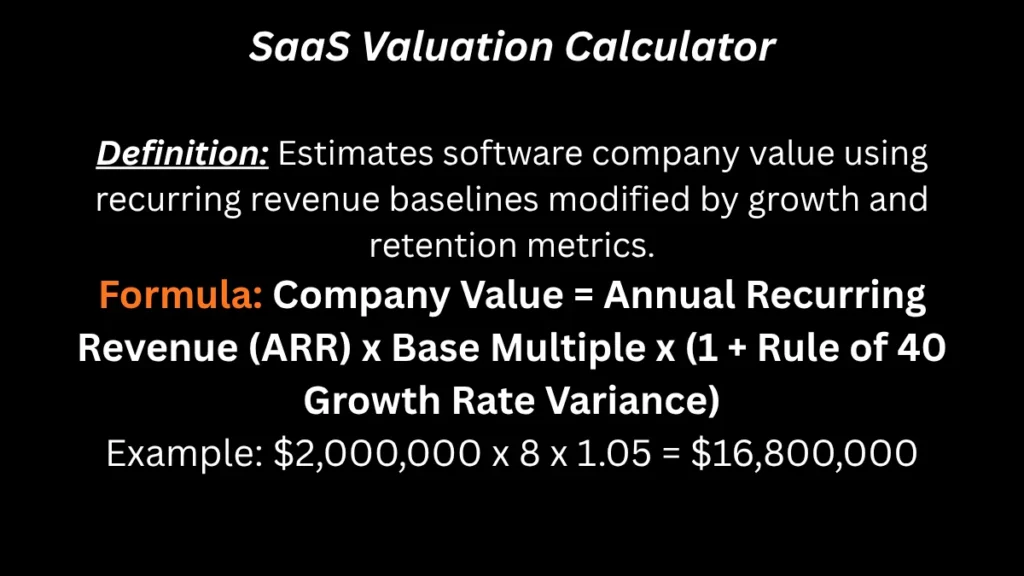
SaaS Valuation Calculator for Tech Startups
Estimating the value of a SaaS business is one of the most challenging tasks for founders, investors, and buyers. Unlike traditional businesses with physical assets and stable revenue, SaaS companies are valued on recurring revenue, growth potential, and future profitability. A SaaS Valuation Calculator offers a fast way to get a preliminary estimate of what your company might be worth.
This guide explains how these calculators work, the formulas behind them, and how to use them correctly. You will learn what inputs matter, how metrics like ARR, churn, and growth affect valuation, and why an online estimate is a starting point—not a guaranteed selling price. Whether you are preparing for a sale, planning fundraising, or simply tracking your business value, understanding the numbers is essential.
What Is a SaaS Valuation Calculator?
A SaaS Valuation Calculator is an online tool that estimates the value of a software-as-a-service company. It uses financial and operational inputs—such as annual recurring revenue, growth rate, and a valuation multiple—to produce a dollar estimate.
This tool is designed for:
- SaaS founders preparing for a sale or fundraising
- Investors evaluating potential acquisitions
- Business buyers screening SaaS opportunities
- Entrepreneurs tracking the value of their company
- Advisors conducting preliminary analysis
People use these calculators because they offer a quick, affordable way to get a ballpark figure. A professional valuation can cost thousands of dollars and take weeks. A calculator gives you a directional estimate in minutes, helping you decide whether a deeper analysis is worth pursuing.
How Does a SaaS Valuation Calculator Work?
Most SaaS valuation calculators rely on a revenue multiple approach. The process is straightforward:
- You input the company’s recurring revenue. This is typically ARR or MRR.
- You provide a valuation multiple. This is a number that reflects the company’s growth, profitability, and risk profile.
- The calculator multiplies revenue by the multiple. The result is the estimated valuation.
Some calculators may ask for additional inputs like growth rate, churn, or profit margin to adjust the multiple. But the core logic remains the same. The accuracy of the output depends on the accuracy of your inputs and the reasonableness of the multiple you choose.
[Internal link opportunity: Revenue Multiple Calculator]
SaaS Valuation Formula
The most common simplified formula for SaaS valuation is:
Estimated SaaS Value = ARR × Valuation Multiple
Here is what each term means:
- ARR (Annual Recurring Revenue): The recurring subscription revenue a SaaS company expects to generate over a year.
- Valuation Multiple: A number applied to recurring revenue to estimate value. It reflects growth, profitability, retention, and market conditions.
Example:
- ARR = $1,000,000
- Valuation Multiple = 5×
Estimated Value = $1,000,000 × 5 = $5,000,000
This formula is a starting point. Actual market valuation can differ significantly based on many factors. The multiple is not a fixed number—it varies by company, market, and economic conditions.
How to Use a SaaS Valuation Calculator
Using a calculator is simple, but you need to gather the right information first. Here are the typical inputs:
- Monthly Recurring Revenue (MRR): The predictable subscription revenue received each month.
- Annual Recurring Revenue (ARR): MRR multiplied by 12. Some calculators accept either MRR or ARR.
- Annual Revenue: Total revenue for the year, including one-time fees. Use with caution.
- Revenue Growth Rate: The percentage increase in revenue year over year.
- Profit Margin: The percentage of revenue that becomes profit after expenses.
- Churn Rate: The percentage of customers or revenue lost each year.
- Customer Retention: The percentage of customers who stay.
- Valuation Multiple: The multiple you apply to revenue or profit.
- EBITDA or Operating Profit: Earnings before interest, taxes, depreciation, and amortization.
- Customer Concentration: The percentage of revenue from your largest customers.
Not every calculator uses every input. Check the tool’s instructions and use the inputs that are most relevant to your business.
What Is ARR and Why Does It Matter?
ARR, or Annual Recurring Revenue, is the recurring subscription revenue a SaaS company expects to generate over a year. It is the most important metric for SaaS valuation because it represents predictable, repeatable income.
ARR vs. MRR vs. One-Time Revenue:
| Revenue Type | Definition | Example |
|---|---|---|
| ARR | Annual recurring revenue from subscriptions | $1,200,000 |
| MRR | Monthly recurring revenue from subscriptions | $100,000 |
| One-Time Revenue | Non-recurring fees (setup, consulting) | $50,000 |
Recurring revenue is more valuable than one-time revenue because it is predictable. A SaaS company with $1 million in ARR is generally worth more than a services company with $1 million in one-time project revenue.
Example:
If a SaaS company has 100 customers paying $1,000 per month, MRR is $100,000. ARR is $100,000 × 12 = $1,200,000.
[Internal link opportunity: ARR Calculator]
What Is a SaaS Revenue Multiple?
A revenue multiple is a number used to estimate the value of a SaaS company relative to its recurring revenue. It is expressed as a multiplier, such as 3×, 5×, or 10×.
Example:
- ARR = $500,000
- Multiple = 4×
- Estimated value = $500,000 × 4 = $2,000,000
Different SaaS companies receive different multiples. A high-growth, low-churn company with strong retention may command a higher multiple. A slow-growing company with high churn may receive a lower multiple.
Multiples vary by market conditions, company size, growth rate, profitability, and revenue quality. There is no single “correct” multiple. Search volume and keyword difficulty for terms like “SaaS revenue multiple” should be verified using a current keyword research tool.
[Internal link opportunity: SaaS Metrics Calculator]
How Growth Rate Affects SaaS Valuation
Growth is one of the strongest drivers of SaaS valuation. A company growing at 100% year over year is typically valued at a higher multiple than one growing at 10%.
Numerical Comparison:
- Company A: ARR = $1,000,000, Growth = 80%, Multiple = 8×, Estimated Value = $8,000,000
- Company B: ARR = $1,000,000, Growth = 15%, Multiple = 3×, Estimated Value = $3,000,000
The difference in estimated value is significant, even though both companies have the same ARR.
Growth is not the only factor. A company with high growth but high churn may be less valuable than a slower-growing company with excellent retention. Growth should be considered alongside profitability, retention, and market opportunity.
How Churn and Customer Retention Affect Valuation
Churn is the percentage of customers or revenue lost over a period. High churn reduces the predictability of recurring revenue, which can lower the valuation multiple.
Customer Churn vs. Revenue Churn:
- Customer churn: The percentage of customers who cancel.
- Revenue churn: The percentage of revenue lost from cancellations and downgrades.
Example:
If a SaaS company starts the year with 100 customers and ends with 85, customer churn is 15%.
Low churn and high retention make revenue more predictable. Predictable revenue is more valuable to buyers and investors. A company with 5% annual churn is generally more valuable than one with 25% churn, all else being equal.
SaaS Valuation Example
Here are three numerical examples to illustrate how the formula works.
Example 1: Basic Valuation
- ARR: $1,000,000
- Multiple: 4×
- Estimated valuation: $1,000,000 × 4 = $4,000,000
Example 2: Higher ARR and Multiple
- ARR: $2,000,000
- Multiple: 5×
- Estimated valuation: $2,000,000 × 5 = $10,000,000
Example 3: Changing the Multiple
Using the same ARR of $1,000,000:
- At a 2× multiple: $1,000,000 × 2 = $2,000,000
- At a 5× multiple: $1,000,000 × 5 = $5,000,000
- At an 8× multiple: $1,000,000 × 8 = $8,000,000
This shows how sensitive SaaS valuation is to the multiple applied.
Important SaaS Valuation Factors
Several factors influence the valuation of a SaaS company. Some are within the founder’s control; others are market-driven.
- ARR: Higher recurring revenue increases value.
- MRR: Monthly recurring revenue is the building block of ARR.
- Revenue Growth: Faster growth typically commands a higher multiple.
- Profitability: Profitable companies may receive higher multiples than unprofitable ones.
- EBITDA: Earnings before interest, taxes, depreciation, and amortization. A measure of operating profit.
- Gross Margin: The percentage of revenue remaining after direct costs. High gross margins are typical in SaaS.
- Customer Churn: Lower churn increases predictability and value.
- Net Revenue Retention: The percentage of revenue retained from existing customers, including upgrades. Above 100% means existing customers are spending more over time.
- Customer Acquisition: Efficient acquisition supports growth.
- Customer Concentration: If a few customers represent most revenue, risk is higher.
- Recurring Revenue Quality: Predictable, contracted revenue is more valuable.
- Market Size: A large addressable market supports growth potential.
- Competitive Position: A strong market position can justify a higher multiple.
- Product Maturity: A proven product reduces risk.
- Founder Dependence: A business that relies heavily on the founder is riskier.
- Geographic Market: Different markets may have different multiples.
- Customer Contracts: Long-term contracts add stability.
- Revenue Predictability: Predictable revenue is more valuable.
Not all factors receive equal weight. The importance of each factor depends on the buyer, the market, and the stage of the company.
SaaS Revenue Multiple vs. Profit Multiple
There are two common approaches to SaaS valuation: revenue multiples and profit multiples.
| Approach | Basis | Best Used For |
|---|---|---|
| Revenue Multiple | ARR or revenue | High-growth companies with little or no profit |
| Profit Multiple | EBITDA or net profit | Established, profitable companies |
Revenue multiples are common for early-stage and high-growth SaaS companies. Profit multiples are more common for mature, profitable companies. Some buyers use a combination of both.
SaaS Valuation Methods
Several valuation methods are used in the SaaS industry. A calculator may use a simplified version of one or more of these.
- Revenue Multiple Method: Values the company as a multiple of recurring revenue.
- EBITDA or Profit Multiple Method: Values the company as a multiple of profit.
- Discounted Cash Flow (DCF): Projects future cash flows and discounts them to present value.
- Comparable Company Approach: Compares the company to similar public or private companies.
- Comparable Transaction Approach: Compares the company to recent acquisition deals.
Each method has strengths and limitations. No single method is perfect for every situation.
Startup Stage and Valuation
The stage of a SaaS business affects its valuation.
- Early-Stage SaaS: Limited revenue, high risk. Valuation may be based on potential rather than current metrics.
- Growing SaaS: Increasing ARR, improving retention. Revenue multiples become more relevant.
- Established SaaS: Consistent revenue, predictable growth. Profitability and retention drive value.
- Profitable SaaS: Strong margins, stable growth. EBITDA multiples may be used.
Very early startups may have limited historical revenue and may require different valuation considerations. Multiples vary according to market conditions, company size, growth, profitability, revenue quality, and other factors.
How Accurate Is a SaaS Valuation Calculator?
An online calculator provides an estimate, not a formal business valuation. Its accuracy depends on the quality of your inputs and the assumptions built into the tool.
Factors that can reduce accuracy include:
- Incorrect revenue figures
- Unrealistic growth assumptions
- Incorrect valuation multiple
- Poor churn data
- Customer concentration
- One-time revenue treated as recurring
- Unusual expenses
- Market conditions
- Business-specific risks
A calculator is a screening tool. For major transactions, professional valuation advice is often appropriate.
Common SaaS Valuation Mistakes
Avoid these common errors:
- Using total revenue instead of recurring revenue: One-time revenue is less valuable.
- Confusing MRR with ARR: MRR is monthly; ARR is annual.
- Applying a multiple without considering business quality: A high multiple requires strong fundamentals.
- Ignoring churn: High churn reduces value.
- Ignoring profitability: Profitability affects the multiple.
- Overestimating growth: Unrealistic projections reduce credibility.
- Including one-time revenue as recurring: This inflates ARR and value.
- Ignoring customer concentration: Few customers mean higher risk.
- Treating calculator output as a guaranteed selling price: It is an estimate.
- Comparing a small SaaS business directly with a much larger company: Size affects multiples.
How to Improve a SaaS Company’s Valuation
Practical steps to improve valuation:
- Increase recurring revenue through new customers and upgrades.
- Improve customer retention by reducing churn.
- Reduce unnecessary churn by addressing customer pain points.
- Improve margins by controlling costs.
- Build predictable revenue through contracts and annual plans.
- Diversify customers to reduce concentration risk.
- Reduce founder dependence by building a strong team.
- Maintain clean financial records.
- Improve operational efficiency.
- Demonstrate sustainable growth.
These actions may improve valuation, but they do not guarantee a higher price.
SaaS Valuation Calculator vs. Professional Valuation
| Feature | SaaS Valuation Calculator | Professional Valuation |
|---|---|---|
| Purpose | Quick estimate | Formal opinion of value |
| Speed | Minutes | Days or weeks |
| Cost | Free or low cost | Thousands of dollars |
| Data Required | Basic financial inputs | Detailed financial and operational data |
| Level of Detail | Simplified | Comprehensive |
| Typical Use | Screening, planning | Transactions, legal, tax |
| Accuracy Limitations | Depends on inputs | Based on professional analysis |
An online calculator is useful for an initial estimate. It does not replace professional valuation work for major transactions.
When Should You Use a SaaS Valuation Calculator?
Use a calculator in these situations:
- Preparing for a potential sale
- Evaluating an acquisition opportunity
- Tracking business value over time
- Planning fundraising
- Comparing growth scenarios
- Reviewing business performance
- Preparing preliminary discussions with investors
- Understanding the effect of revenue growth
- Testing different valuation multiples
Frequently Asked Questions
1. What is a SaaS Valuation Calculator?
It is an online tool that estimates the value of a SaaS company using inputs like ARR, growth, and a valuation multiple.
2. How do you calculate the value of a SaaS company?
The most common simplified method is: Estimated Value = ARR × Valuation Multiple.
3. What is the SaaS valuation formula?
Estimated SaaS Value = ARR × Valuation Multiple. ARR is annual recurring revenue. The multiple reflects growth, profitability, and risk.
4. How is ARR used to value a SaaS company?
ARR is multiplied by a valuation multiple to produce an estimated value. Higher ARR generally means higher value.
5. What is a SaaS revenue multiple?
It is a number applied to recurring revenue to estimate value. Multiples vary by company and market.
6. How does MRR affect SaaS valuation?
MRR is the monthly building block of ARR. Higher MRR leads to higher ARR and potentially higher valuation.
7. Does SaaS growth increase company valuation?
Growth is a strong driver of valuation. Faster-growing companies often receive higher multiples.
8. How does churn affect SaaS valuation?
High churn reduces revenue predictability and can lower the valuation multiple.
9. Can I value a SaaS startup using revenue?
Yes, revenue multiples are commonly used for early-stage and high-growth SaaS companies.
10. How accurate is a SaaS valuation calculator?
It provides an estimate. Accuracy depends on your inputs and market assumptions. It is not a formal valuation.
11. What is the difference between ARR and MRR?
ARR is annual recurring revenue. MRR is monthly recurring revenue. ARR = MRR × 12.
12. What factors affect SaaS company valuation?
ARR, growth, profitability, churn, retention, customer concentration, market size, and competitive position.
13. Is a SaaS valuation calculator suitable for early-stage startups?
It can provide a rough estimate, but early-stage startups may require different valuation considerations.
14. Can a SaaS calculator determine the actual selling price?
No. It provides an estimated value. The actual selling price depends on negotiations and market conditions.
Related Calculators and Tools
- EBITDA based business valuation estimator
- SaaS metrics calculator for startups
- how to calculate MRR for a SaaS business
- how to calculate ARR for a SaaS company
- customer lifetime value for SaaS startups
- how to calculate churn rate for SaaS
- solar panel payback and ROI calculator
Summary
A SaaS Valuation Calculator is a practical tool for estimating the value of a software business. It uses recurring revenue and a valuation multiple to produce a quick estimate. ARR and MRR are the foundation of SaaS valuation because recurring revenue is predictable and valuable.
Valuation multiples vary based on growth, retention, profitability, and revenue quality. No single multiple applies to every company. Calculator results should be treated as estimates, not guaranteed selling prices. For major transactions, professional valuation advice is recommended.