What Is a Mortgage Calculator for Self-Employed Borrowers?
A Mortgage Calculator for Self-Employed Borrowers estimates monthly mortgage payments and, in some cases, affordability based on income and debts. It calculates principal and interest using the loan amount, interest rate, and term.
The calculator can also estimate total monthly housing costs when you input property taxes, insurance, mortgage insurance, and HOA fees.
What the calculator cannot do is determine whether you qualify for a mortgage. Qualification depends on lender underwriting, which includes income verification, credit review, debt analysis, and documentation. A borrower may be able to calculate a payment but still need to meet a lender’s specific requirements.
Mortgage Calculator for Self-Employed Borrowers
Estimate your mortgage payment and potential borrowing amount using self-employed income, business expenses, debts, and down payment.
Qualifying Income = Business Income − Business Expenses + Allowable Add-Backs + Other Income
2. Estimated Qualifying Monthly Income
Qualifying Monthly Income = Qualifying Annual Income ÷ 12
3. Mortgage Loan Amount
Mortgage Loan = Home Price − Down Payment
4. Principal & Interest Payment
Monthly Payment = P × [r(1 + r)n] ÷ [(1 + r)n − 1]
P = Mortgage Loan Amount
r = Annual Interest Rate ÷ 12 ÷ 100
n = Mortgage Term × 12
5. Estimated Monthly Housing Payment
Total Housing Payment = Principal & Interest + Property Tax ÷ 12 + Home Insurance ÷ 12 + HOA
6. Estimated DTI Payment Limit
Maximum Housing + Debt Payment = Qualifying Monthly Income × Maximum DTI
7. Estimated Payment Capacity
Payment Capacity = Maximum Housing + Debt Payment − Other Monthly Debts
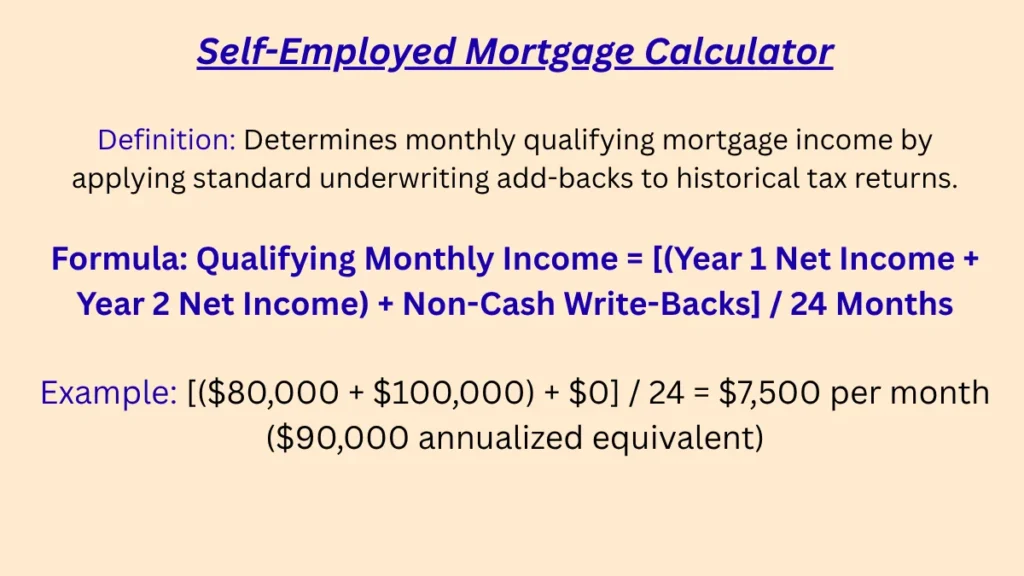
How Does a Self-Employed Mortgage Calculator Work?
The calculator performs a standard amortizing loan calculation for the mortgage payment. You input:
- Home price
- Down payment
- Loan amount
- Interest rate
- Loan term
- Property taxes
- Homeowners insurance
- Mortgage insurance where applicable
- HOA fees where applicable
For self-employed borrowers, affordability calculations may also consider:
- Business revenue
- Business expenses
- Net income
- Ownership percentage
- Income history
- Income stability
- Lender-specific adjustments
The payment calculation is mathematical. The income evaluation is underwriting. These are separate processes.
Mortgage Payment Formula
The standard fixed-rate mortgage formula is:
M = P × [r(1 + r)^n] ÷ [(1 + r)^n − 1]
Where:
- M = monthly principal and interest payment
- P = loan principal
- r = monthly interest rate (annual rate ÷ 12)
- n = total number of monthly payments (years × 12)
Principal and interest are only part of the total monthly housing payment. The complete payment may also include property taxes, homeowners insurance, mortgage insurance, HOA dues, and other applicable costs.
How Self-Employed Income Is Different
Lenders cannot simply look at a paycheck stub when evaluating a self-employed borrower. Instead, they review business financials to determine qualifying income.
Key concepts include:
- Business revenue: Total money coming into the business.
- Business expenses: Costs of running the business.
- Net business income: Revenue minus expenses.
- Ownership percentage: Your share of the business.
- Income consistency: How stable income has been over time.
- Year-to-year changes: Whether income is growing, flat, or declining.
- Business structure: Sole proprietor, partnership, S corporation, or corporation.
- Documentation: Tax returns, profit and loss statements, bank statements.
Lenders may not simply use total deposits or gross revenue as qualifying income. They typically adjust income based on tax returns and may add back certain non-cash expenses. Treatment varies by lender and loan program.
Gross Income vs. Net Self-Employed Income
Gross business revenue is total income before expenses.
Net business income is revenue minus business expenses.
Example:
- Business revenue: $150,000
- Business expenses: $60,000
- Net business income: $90,000
This is a simplified example. Actual lender income calculations can include adjustments and may differ from tax-return figures. Not every lender uses the same formula.
What Income Can Self-Employed Borrowers Use?
Potentially relevant income sources include:
- Sole proprietor income
- Partnership income
- S corporation income
- Corporation income
- Freelance income
- Contractor income
- Professional practice income
- Business distributions where permitted
- Other documented qualifying income
Treatment varies by lender, loan program, ownership percentage, documentation, and borrower circumstances. A particular income source does not automatically qualify.
How Much Mortgage Can a Self-Employed Person Afford?
Affordability depends on:
- Qualifying income
- Monthly debt
- Credit profile
- Down payment
- Interest rate
- Loan term
- Property taxes
- Insurance
- Mortgage insurance
- HOA fees
- Lender requirements
Debt-to-Income Ratio (DTI):
DTI = Total Monthly Debt Payments ÷ Gross Monthly Qualifying Income × 100
A calculator can estimate affordability, but lenders may calculate qualifying income and DTI differently.
Self-Employed Mortgage Payment Example
Illustrative Scenario:
- Home price: $400,000
- Down payment: $80,000
- Loan amount: $320,000
- Interest rate: 7%
- Loan term: 30 years
Monthly rate: 0.07 ÷ 12 = 0.005833
Number of payments: 30 × 12 = 360
M = 320,000 × [0.005833 × (1.005833)^360] ÷ [(1.005833)^360 − 1]
M ≈ $2,128.98
This is principal and interest only. Taxes, insurance, mortgage insurance, and HOA fees may increase the total monthly housing payment.
How Does a Down Payment Affect a Self-Employed Mortgage?
A larger down payment:
- Reduces the loan amount
- Reduces principal and interest payments
- Reduces total interest over the loan term
- May affect mortgage insurance requirements depending on the loan
Home price: $400,000 | Rate: 7% | Term: 30 years
| Down Payment | Loan Amount | Monthly Payment |
|---|---|---|
| $40,000 | $360,000 | $2,395.10 |
| $80,000 | $320,000 | $2,128.98 |
| $120,000 | $280,000 | $1,862.86 |
How Does the Interest Rate Affect Payments?
Loan amount: $320,000 | Term: 30 years
| Rate | Monthly Payment |
|---|---|
| 5% | $1,717.79 |
| 6% | $1,918.56 |
| 7% | $2,128.98 |
| 8% | $2,347.90 |
These are hypothetical rates for illustration. They are not current market rates.
How Does the Loan Term Affect Cost?
Loan amount: $320,000 | Rate: 7%
| Term | Monthly Payment | Total Interest |
|---|---|---|
| 15 years | $2,876.36 | $197,744.80 |
| 20 years | $2,481.18 | $275,483.20 |
| 30 years | $2,128.98 | $446,432.80 |
Shorter terms have higher monthly payments but less total interest. Longer terms have lower monthly payments but more total interest.
Self-Employed Mortgage vs. Regular Mortgage
| Factor | Self-Employed Mortgage | Regular Mortgage |
|---|---|---|
| Income documentation | Tax returns, P&L, bank statements | Pay stubs, W-2s |
| Income calculation | Adjusted business income | Gross salary |
| Business expenses | Reduce qualifying income | Not applicable |
| Tax returns | Typically required | Not required |
| Underwriting | More detailed income review | Standard review |
| Payment calculation | Same formula | Same formula |
| Credit requirements | Similar | Similar |
| DTI assessment | Based on qualifying income | Based on salary |
The mortgage itself is not necessarily a different type of loan. The major difference is how income is documented and evaluated.
What Documents May Self-Employed Borrowers Need?
Lenders may request:
- Personal tax returns
- Business tax returns
- Profit and loss statements
- Balance sheets
- Bank statements
- Business ownership documentation
- 1099 forms where applicable
- Business licenses
- Proof of assets
- Debt information
Documentation requirements vary by lender and loan program. Not every borrower needs every document.
How Business Expenses Can Affect Mortgage Qualifying Income
Business expenses reduce reported business income. This can lower the income a lender uses to qualify you for a mortgage.
Example:
- Business revenue: $200,000
- Deductible expenses: $80,000
- Reported taxable income: $120,000
- Lender-adjusted qualifying income: May be higher or lower depending on add-backs and adjustments
Distinguish between:
- Actual business revenue
- Deductible expenses
- Reported taxable income
- Lender-adjusted qualifying income
Some underwriting methods may add back certain non-cash expenses like depreciation. Treatment varies.
Can Self-Employed Borrowers Use Bank Statements?
Some mortgage programs or lenders may consider bank statements as part of alternative income documentation. This is sometimes called a bank statement loan.
Considerations include:
- Personal bank statements
- Business bank statements
- Deposits
- Business expenses
- Documentation requirements
Bank-statement loans are not available from every lender. Qualification is not guaranteed.
Self-Employed Mortgage and Debt-to-Income Ratio
DTI compares monthly debt payments to gross monthly qualifying income.
Formula:
DTI = Total Monthly Debt Payments ÷ Gross Monthly Qualifying Income × 100
Example:
- Qualifying monthly income: $10,000
- Monthly debt payments: $3,000
- DTI = $3,000 ÷ $10,000 × 100 = 30%
Lenders may calculate qualifying income and debt obligations differently. A specific DTI percentage does not guarantee approval.
Self-Employed Mortgage Affordability Example
Illustrative Scenario:
- Qualifying monthly income: $8,000
- Existing debt payments: $1,500
- Estimated new housing payment: $2,000
- Total monthly debts: $3,500
- DTI = $3,500 ÷ $8,000 × 100 = 43.75%
This is an educational example, not an approval calculation. Lenders may have different DTI limits and income calculations.
What Affects a Self-Employed Mortgage Payment?
- Home price
- Down payment
- Loan amount
- Interest rate
- Loan term
- Property taxes
- Insurance
- Mortgage insurance
- HOA fees
- Loan type
- Points or lender costs where applicable
Self-employment itself does not automatically change the mathematical mortgage payment once the loan amount, rate, and term are known.
How to Use the Mortgage Calculator for Self-Employed Borrowers
- Enter the home price.
- Enter the down payment.
- Enter the estimated interest rate.
- Select the loan term.
- Enter property taxes if supported.
- Enter homeowners insurance if supported.
- Enter mortgage insurance if applicable.
- Enter HOA fees if applicable.
- Enter estimated qualifying self-employed income if the calculator supports affordability.
- Enter monthly debt payments if supported.
- Click Calculate.
- Review the estimated monthly payment.
- Review principal and interest.
- Review estimated total housing costs.
- Compare different down payments and interest rates.
- Compare the estimate with actual lender qualification results.
How to Improve Mortgage Readiness When Self-Employed
- Keep business and personal records organized
- Maintain consistent documentation
- Understand reported income
- Review tax returns before applying
- Track monthly debts
- Maintain an emergency reserve
- Compare mortgage offers
- Understand loan costs
- Avoid focusing only on the monthly payment
- Keep documentation readily available
These are general strategies, not personalized financial advice. Do not manipulate tax returns or business records to qualify for a mortgage.
Costs Beyond the Mortgage Payment
- Property taxes
- Homeowners insurance
- Mortgage insurance
- HOA fees
- Maintenance
- Repairs
- Utilities
- Closing costs
- Homeowners association assessments
- Refinancing costs where applicable
Principal and interest is not the complete cost of owning a home.
Self-Employed Borrower Mortgage Calculation Table
| Home Price | Down Payment | Loan Amount | Rate | Term | Estimated Monthly P&I |
|---|---|---|---|---|---|
| $300,000 | $60,000 | $240,000 | 7% | 30 yr | $1,596.73 |
| $400,000 | $80,000 | $320,000 | 7% | 30 yr | $2,128.98 |
| $500,000 | $100,000 | $400,000 | 7% | 30 yr | $2,661.22 |
These are illustrative examples.
How Accurate Is a Self-Employed Mortgage Calculator?
The calculator provides an estimate but cannot reproduce every lender's underwriting process.
Actual results may differ because of:
- Lender-specific income calculations
- Tax-return adjustments
- Business ownership
- Qualifying income
- Credit
- Debt-to-income calculations
- Interest rate
- Loan program
- Property taxes
- Insurance
- Mortgage insurance
- Fees
- Underwriting rules
Calculator results are estimates, not mortgage approvals.
Common Self-Employed Mortgage Calculator Mistakes
- Entering business revenue instead of qualifying income
- Ignoring business expenses
- Confusing gross and net income
- Using an unrealistic interest rate
- Forgetting taxes and insurance
- Ignoring mortgage insurance
- Forgetting existing debt
- Focusing only on principal and interest
- Assuming the calculator determines approval
- Assuming all lenders calculate self-employed income identically
- Ignoring documentation requirements
- Using outdated income information
When Is This Calculator Most Useful?
- Planning to buy a home
- Estimating affordability
- Comparing home prices
- Comparing down payments
- Comparing mortgage rates
- Estimating monthly housing costs
- Preparing for a mortgage application
- Comparing loan terms
- Understanding the effect of existing debt
Related Calculators and Tools
- Self-Employed Mortgage Calculator: A focused tool for estimating payments based on self-employment income.
- HELOC Payment Calculator: Helps estimate home equity line of credit payments if you are self-employed.
- Rental Property Calculator: Useful for self-employed borrowers who also invest in rental income properties.
Frequently Asked Questions
What is a Mortgage Calculator for Self-Employed Borrowers?
It is a tool that estimates monthly mortgage payments based on home price, down payment, interest rate, and loan term. Some versions also estimate affordability based on income and debts.
How do lenders calculate self-employed income?
Lenders typically review tax returns, profit and loss statements, and bank statements. They may adjust income based on business expenses and add back certain non-cash items. Methods vary by lender and loan program.
How much mortgage can a self-employed person afford?
It depends on qualifying income, debts, credit, down payment, and lender requirements. A calculator can estimate, but lenders determine actual qualification.
Can self-employed people qualify for a mortgage?
Yes. Many lenders offer mortgages to self-employed borrowers. Qualification depends on income documentation, credit, debts, and the specific loan program.
Do mortgage lenders use gross or net income for self-employed borrowers?
Lenders generally use net business income after adjustments, not gross revenue. Treatment varies by lender and loan program.
How many years of self-employed income do lenders need?
Many lenders request two years of tax returns. Requirements vary by lender and loan program. Some may accept less with compensating factors.
Can business expenses reduce mortgage qualifying income?
Yes. Business expenses reduce reported income, which can lower the income a lender uses to qualify you.
Can a business owner get a mortgage?
Yes. Business owners can qualify for mortgages. The process involves additional documentation and income evaluation.
Can freelancers qualify for a mortgage?
Yes. Freelancers can qualify using tax returns and other documentation. Requirements vary by lender.
Can self-employed borrowers use bank statements?
Some lenders offer bank statement loans as alternative documentation. Availability and requirements vary.
What documents do self-employed borrowers need for a mortgage?
Common documents include personal and business tax returns, profit and loss statements, bank statements, and business ownership documentation.
Does being self-employed make getting a mortgage harder?
It can add complexity because income documentation is more detailed. It does not automatically make approval harder or easier.
How does a down payment affect a self-employed mortgage?
A larger down payment reduces the loan amount and monthly payment. It may also affect mortgage insurance requirements.
What is the difference between mortgage affordability and mortgage qualification?
Affordability is what you can comfortably pay. Qualification is what a lender will approve based on underwriting.
How accurate is a self-employed mortgage calculator?
It provides an estimate. Actual qualification depends on lender underwriting, income calculations, and documentation.
Summary
A Mortgage Calculator for Self-Employed Borrowers estimates monthly mortgage payments based on home price, down payment, interest rate, and loan term. It can also estimate total housing costs when taxes, insurance, and other fees are included.
Self-employed income requires additional documentation. Lenders review tax returns, profit and loss statements, and bank statements to determine qualifying income. Business revenue and qualifying income are not always the same.
Down payment, interest rate, and loan term affect payments. Taxes, insurance, and other costs add to the total. Calculator results are estimates, not mortgage approvals. Compare lender terms and review the full financing agreement before making a decision.