What Is DSCR?
DSCR, or Debt Service Coverage Ratio, measures how many times a property’s net operating income covers its annual debt service.
DSCR = Net Operating Income (NOI) ÷ Annual Debt Service
The result is expressed as a number with an “x” notation. For example:
- DSCR of 1.00x = income exactly equals annual debt service
- DSCR of 1.25x = income is 1.25 times annual debt service
- DSCR of 1.50x = income is 1.50 times annual debt service
- DSCR below 1.00x = income does not fully cover annual debt service
A DSCR above 1.0 means the property generates more income than needed to pay its debt. A DSCR below 1.0 means the property does not generate enough income to cover its debt obligations from operations alone.
Free DSCR Calculator (Debt Service Coverage Ratio)
This calculator provides an estimate for informational purposes only. Actual DSCR requirements and calculations may vary by lender, loan type, property, and financial situation.
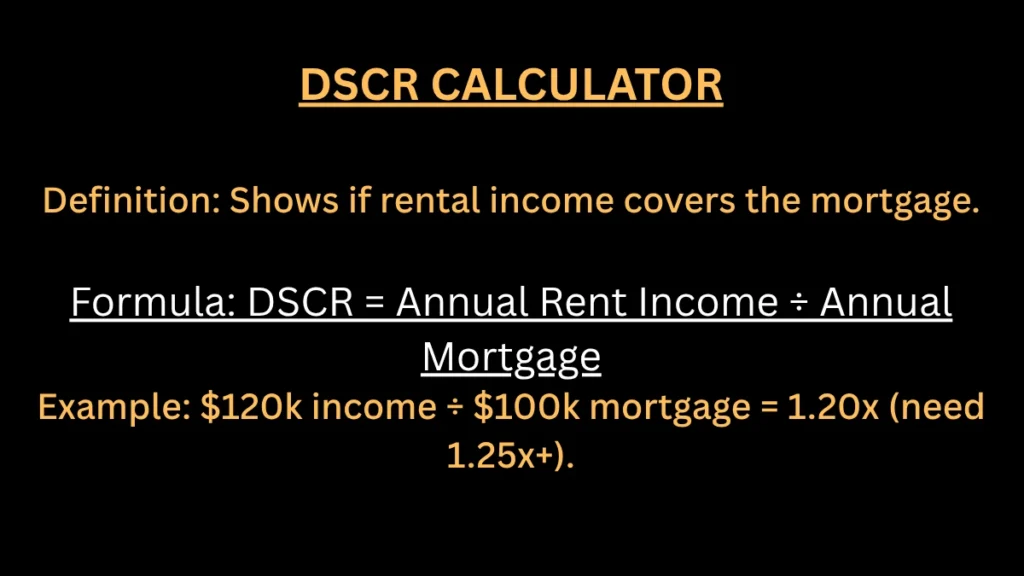
DSCR Formula
DSCR = NOI ÷ Annual Debt Service
NOI (Net Operating Income): The property’s income after operating expenses, but before debt payments and income taxes.
Annual Debt Service: The total principal and interest payments required over the measurement period, typically one year.
The exact DSCR methodology can vary by lender or loan program. Some lenders may adjust NOI calculations or include different expenses in their underwriting.
How to Calculate DSCR Step by Step
Step 1: Determine gross property income (rental income plus other property income).
Step 2: Account for vacancy or collection loss where appropriate.
Step 3: Subtract applicable operating expenses (property taxes, insurance, maintenance, management fees, utilities paid by owner).
Step 4: Calculate NOI.
Step 5: Determine annual debt service (monthly principal and interest payment × 12).
Step 6: Divide NOI by annual debt service.
Step 7: Interpret the result.
Numerical Example:
- Annual NOI = $120,000
- Annual Debt Service = $96,000
- DSCR = $120,000 ÷ $96,000 = 1.25x
This means the property generates $1.25 of net operating income for every $1.00 of annual debt service.
Net Operating Income (NOI)
NOI represents property operating income after applicable operating expenses, but before financing costs.
Potential Income Sources:
- Rental income
- Parking income
- Laundry income
- Service fees
- Other recurring property revenue
Potential Operating Expenses:
- Property taxes
- Insurance
- Property management fees
- Repairs and maintenance
- Utilities paid by the owner
- Landscaping
- Administrative costs
- HOA dues (if applicable)
NOI is not:
- Gross rental income
- Cash flow after debt service
- Taxable income
- Profit after financing
NOI excludes mortgage payments, depreciation, and capital expenditures.
Annual Debt Service
For a standard amortizing loan, annual debt service includes principal and interest payments.
Annual Debt Service = Monthly Principal and Interest Payment × 12
The standard amortization formula for calculating monthly payment:
M = P × [r(1 + r)^n] ÷ [(1 + r)^n − 1]
Where:
- M = monthly payment
- P = loan principal
- r = monthly interest rate (annual rate ÷ 12)
- n = total number of payments (years × 12)
Actual commercial or investment-property loans can have different structures, including interest-only periods, variable rates, balloon payments, or other terms.
DSCR Calculator Inputs
Common inputs for a DSCR calculator include:
- Annual rental income
- Other property income
- Vacancy rate
- Operating expenses
- Annual NOI (if entered directly)
- Loan amount
- Interest rate
- Loan term
- Monthly payment
- Annual debt service
- Target DSCR
If the calculator allows you to enter NOI directly, you do not need to separately calculate rental income and expenses within the tool.
Free DSCR Calculator: How to Use It
Step 1: Enter annual NOI or calculate NOI from property income and expenses.
Step 2: Enter loan amount and financing terms if the calculator calculates debt service.
Step 3: Enter interest rate.
Step 4: Enter loan term.
Step 5: Click Calculate.
Step 6: Review monthly payment if provided.
Step 7: Review annual debt service.
Step 8: Review DSCR.
Step 9: Compare the result with the applicable lender or loan-program requirement.
The calculator provides an estimate and does not guarantee loan approval.
DSCR Examples
Example 1:
- NOI = $60,000
- Annual Debt Service = $48,000
- DSCR = $60,000 ÷ $48,000 = 1.25x
Example 2:
- NOI = $90,000
- Annual Debt Service = $60,000
- DSCR = $90,000 ÷ $60,000 = 1.50x
Example 3:
- NOI = $75,000
- Annual Debt Service = $80,000
- DSCR = $75,000 ÷ $80,000 = 0.9375x
The third example shows a property that does not fully cover its measured debt service.
What Does a DSCR of 1.0 Mean?
A DSCR of 1.0x means the measured NOI equals the measured annual debt service.
Example:
- NOI = $100,000
- Annual Debt Service = $100,000
- DSCR = 1.00x
This leaves no operating-income cushion above the measured debt service. Any decline in income or increase in expenses could push the property below break-even.
What Does a DSCR of 1.25 Mean?
A DSCR of 1.25x means the property generates $1.25 of NOI for every $1.00 of measured annual debt service.
Example:
- NOI = $125,000
- Annual Debt Service = $100,000
- DSCR = 1.25x
Coverage surplus: $125,000 − $100,000 = $25,000
The 1.25x threshold is commonly discussed in commercial real estate lending, but it is not a universal minimum requirement. Lender requirements vary by program, property type, and borrower circumstances.
What Is a Good DSCR?
| DSCR | General Interpretation |
|---|---|
| Below 1.00x | NOI does not fully cover measured debt service |
| 1.00x | NOI exactly covers measured debt service |
| 1.01x–1.19x | Limited coverage cushion |
| 1.20x–1.24x | Moderate coverage |
| 1.25x | Common underwriting reference point |
| 1.26x–1.49x | Stronger coverage |
| 1.50x+ | Higher coverage cushion |
These descriptions are educational, not universal lender approval categories. A DSCR of 1.25x does not guarantee approval. A DSCR below 1.25x does not mean no lender will approve. Requirements vary by lender and loan program.
DSCR for Rental Property
DSCR is commonly applied to rental property analysis. Lenders may calculate rental-property DSCR differently, with varying approaches to:
- Rental income recognition
- Vacancy assumptions
- Operating expense adjustments
- Management fee treatment
- Replacement reserves
Different lenders may calculate rental-property DSCR differently. Do not assume every lender uses identical expense adjustments.
DSCR for Commercial Real Estate
DSCR is used across commercial property types:
- Multifamily
- Office
- Retail
- Industrial
- Mixed-use
- Hospitality
Lenders may evaluate DSCR alongside other metrics such as LTV and debt yield. The binding constraint—the most restrictive metric—often determines the final loan amount.
DSCR Loans
DSCR-focused investment-property lending may emphasize property cash flow rather than relying solely on the borrower’s personal income. This can be useful for self-employed investors or those with complex tax situations.
However, DSCR loan programs do not ignore personal income entirely. Lenders still evaluate credit, reserves, and other underwriting factors. Requirements vary by lender.
How Loan Terms Affect DSCR
The financing structure can change DSCR:
- Higher loan amount → increases debt service → reduces DSCR
- Higher interest rate → increases payment → reduces DSCR
- Longer amortization → reduces periodic payment → may increase DSCR (but increases total interest)
Example:
- NOI = $100,000
- Loan amount = $1,000,000
- Rate = 7%
| Amortization | Monthly Payment | Annual Debt Service | DSCR |
|---|---|---|---|
| 20 years | $7,752.99 | $93,035.88 | 1.07x |
| 25 years | $7,067.78 | $84,813.36 | 1.18x |
| 30 years | $6,653.02 | $79,836.24 | 1.25x |
Longer amortization can improve DSCR by reducing periodic debt service.
How to Improve DSCR
Practical ways to improve the ratio:
- Increase NOI through higher effective rental income
- Reduce unnecessary operating expenses
- Reduce loan amount through larger down payment
- Obtain better financing terms
- Extend amortization where appropriate
- Improve occupancy and reduce vacancy
- Increase legitimate ancillary income
Increasing income or reducing expenses should not mean using unrealistic projections.
Maximum Debt Service at a Target DSCR
Maximum Annual Debt Service = NOI ÷ Target DSCR
Example:
- NOI = $100,000
- Target DSCR = 1.25x
- Maximum Annual Debt Service = $100,000 ÷ 1.25 = $80,000
This can be useful for preliminary loan sizing. It is not a lender commitment.
DSCR vs LTV
| Metric | What It Measures |
|---|---|
| DSCR | Property income relative to debt service |
| LTV | Loan amount relative to property value |
| Debt Yield | NOI relative to loan amount |
| Cap Rate | NOI relative to property value |
These metrics answer different questions. Lenders often calculate all three and lend to whichever is most restrictive.
DSCR vs Debt Yield
DSCR: Income relative to debt service.
Debt Yield: NOI relative to loan amount.
Debt Yield = NOI ÷ Loan Amount
Interest rate and amortization affect DSCR but do not directly enter the basic debt-yield formula.
Common DSCR Calculation Mistakes
- Using gross rent instead of NOI
- Forgetting vacancy
- Forgetting operating expenses
- Including mortgage payments inside NOI
- Using monthly NOI with annual debt service
- Using annual NOI with monthly debt service
- Using interest-only debt service when loan requires principal and interest
- Double-counting taxes or insurance
- Using projected income without explaining assumptions
- Ignoring lender-specific NOI adjustments
- Confusing DSCR with LTV
- Assuming one DSCR threshold applies to every lender
Accuracy and Limitations
The calculator is an educational estimation tool. Actual underwriting may differ because lenders can adjust:
- NOI calculations
- Vacancy assumptions
- Operating expenses
- Replacement reserves
- Management fees
- Debt service calculations
- Loan terms
- Income recognition
The calculator is not official lender underwriting, loan approval, financial advice, or a guarantee of financing.
Practical Comparison Table
| NOI | Annual Debt Service | DSCR | Interpretation |
|---|---|---|---|
| $60,000 | $60,000 | 1.00x | Break-even coverage |
| $75,000 | $60,000 | 1.25x | 25% coverage cushion |
| $90,000 | $60,000 | 1.50x | 50% coverage cushion |
| $60,000 | $75,000 | 0.80x | Income below debt service |
Frequently Asked Questions
What is DSCR?
DSCR stands for Debt Service Coverage Ratio. It measures how many times a property’s net operating income covers its annual debt service.
What does DSCR stand for?
Debt Service Coverage Ratio.
How do you calculate DSCR?
DSCR = Net Operating Income ÷ Annual Debt Service.
What is the DSCR formula?
DSCR = NOI ÷ Annual Debt Service.
What is a good DSCR?
A DSCR above 1.0 means income covers debt. A DSCR of 1.25x or higher is commonly referenced, but lender requirements vary.
What does a DSCR of 1.25 mean?
It means the property generates $1.25 of NOI for every $1.00 of annual debt service.
What does a DSCR below 1.0 mean?
The property’s income does not fully cover its measured debt service.
Does DSCR use monthly or annual income?
DSCR can be calculated using either monthly or annual figures, as long as NOI and debt service use the same period. Annual is more common.
What is NOI in a DSCR calculation?
NOI is property income after operating expenses but before debt payments and taxes.
Does DSCR include property taxes?
Yes. Property taxes are typically included as operating expenses in NOI.
Does DSCR include insurance?
Yes. Insurance is typically included as an operating expense in NOI.
What expenses are deducted from NOI?
Property taxes, insurance, management fees, maintenance, repairs, utilities paid by owner, and other operating expenses.
What is annual debt service?
The total principal and interest payments required over one year.
How can I improve my DSCR?
Increase NOI, reduce operating expenses, reduce loan amount, or obtain better financing terms.
What DSCR do lenders require?
Requirements vary by lender and loan program. Common thresholds range from 1.10x to 1.25x, but some programs allow lower ratios.
Can I get a DSCR loan with a ratio below 1.25?
Some lenders may allow a DSCR below 1.25 or even below 1.00, often with rate or LTV adjustments. Availability varies.
What is the difference between DSCR and LTV?
DSCR measures income relative to debt service. LTV measures loan amount relative to property value.
What is the difference between DSCR and debt yield?
DSCR focuses on income relative to debt service. Debt yield focuses on NOI relative to loan amount.
Can a DSCR calculator determine how much I can borrow?
It can provide an estimate, but actual loan amounts depend on DSCR, LTV, debt yield, and other underwriting factors.
Is a DSCR calculator accurate for every lender?
No. Lenders may adjust NOI, debt service, and other inputs. The calculator provides an estimate based on your inputs.
Related Calculators and Tools
- Rental Property Calculator: Estimate cash flow and returns for rental investments.
- Cap Rate Calculator: Calculate capitalization rate from NOI and property value.
- Commercial Mortgage Calculator: Estimate payments for commercial property loans.
Summary
A Free DSCR Calculator helps you determine whether a property’s net operating income covers its annual debt service. The DSCR formula is simple: NOI divided by annual debt service.
A DSCR above 1.0 means income covers debt. A DSCR below 1.0 means income falls short. The 1.25x threshold is commonly referenced in commercial lending, but lender requirements vary by program, property type, and borrower circumstances.
NOI is property income after operating expenses but before debt payments. Annual debt service includes principal and interest. Loan amount, interest rate, and amortization all affect DSCR.
Use the calculator to estimate your ratio and compare it with the requirements of the specific loan program you are considering. Calculator results are estimates, not lender underwriting or loan approval. Verify requirements with the actual lender before making financing decisions.