This Commercial Bridge Loan Calculator provides an estimate based on the financing assumptions you enter. Actual bridge-loan terms, fees, underwriting requirements, LTV limits, repayment structures, and costs vary by lender, jurisdiction, property type, and transaction. This is not a loan offer or financial advice.
Commercial Bridge Loan Calculator – How It’s Calculated:
- Max Loan = Property Value × LTV
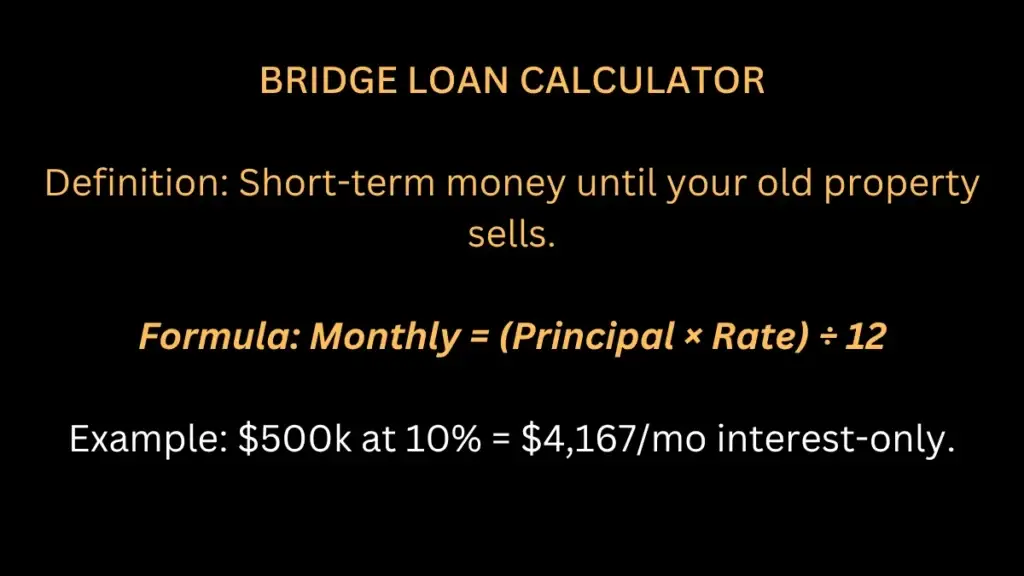
- Interest-Only Payment = Principal × Rate / 12
- Amortized Payment = P × r × (1 + r)^n / ((1 + r)^n − 1)
P = principal
r = monthly rate (annual rate ÷ 12)
n = number of payments
What Is a Commercial Bridge Loan?
A commercial bridge loan is a short-term financing option used to “bridge” a temporary funding gap. Instead of holding a property for years like a traditional commercial mortgage, a bridge loan typically lasts anywhere from a few months to a couple of years.
Borrowers usually turn to bridge financing when they need money quickly and have a clear plan to repay it soon. Common reasons include:
- Buying a new commercial property before selling an existing one
- Waiting for permanent financing to be approved
- Funding a time-sensitive acquisition
- Renovating or repositioning a property to increase its value
- Refinancing temporary debt
- Covering a short-term funding gap
Because bridge loans are short-term and often carry more risk for the lender, they tend to have higher interest rates than traditional commercial loans. The trade-off is speed and flexibility.
What Is a Commercial Bridge Loan Calculator?
A commercial bridge loan calculator is a tool that helps you estimate the potential costs of a short-term commercial loan. You plug in a few key numbers, and it gives you an idea of what you might pay in interest, what your monthly payments could look like, and how much of the property’s value the loan represents.
Most calculators ask for inputs like:
- Property value
- Loan amount
- Interest rate
- Loan term
- Existing debt (if applicable)
- Fees or other financing costs
The results are estimates only. Actual lender terms can vary based on your financial situation, the property type, market conditions, and the lender’s own criteria. Think of the calculator as a starting point for your research — not a final quote.
How to Use the Commercial Bridge Loan Calculator
Using a bridge loan calculator is straightforward. Here’s a simple step-by-step process:
- Enter the property value. This is the current market value or purchase price of the commercial property.
- Enter the requested loan amount. This is how much you want to borrow.
- Enter the estimated interest rate. Use a realistic rate based on current market conditions or lender quotes.
- Enter the loan term. This is how long you expect to hold the bridge loan, usually measured in months.
- Add fees or other applicable costs. Include origination fees, closing costs, or any other charges you expect.
- Click Calculate. The calculator will process your inputs.
- Review the estimated results. Look at the loan-to-value ratio, interest cost, monthly payment, and total financing cost.
Each input matters. A small change in interest rate or loan term can significantly affect your total cost, so it’s worth running a few different scenarios.
What the Calculator Can Help You Estimate
Estimated Loan Amount
The loan amount is the principal you’re borrowing. It’s usually based on a percentage of the property’s value, which is where the loan-to-value ratio comes in. The calculator helps you see how your requested amount compares to the property’s worth.
Loan-to-Value Ratio
Loan-to-value (LTV) is a simple way to measure how much of the property is financed by debt. The formula is:
LTV = Loan Amount ÷ Property Value × 100
For example, if you’re borrowing $700,000 on a property worth $1,000,000, your LTV is 70%.
LTV matters because lenders often cap it. Many commercial bridge loans allow LTVs between 60% and 75%, though this varies. A higher LTV generally means more risk for the lender — and potentially a higher interest rate for you.
Estimated Interest Cost
Interest is the cost of borrowing money. On a short-term bridge loan, even a small difference in rate can add up quickly because the loan balance is often large. The calculator helps you see how much interest you’d pay over the loan term.
Estimated Monthly Interest Payment
Many bridge loans are structured so that you pay interest monthly, with the principal repaid at the end of the term. However, payment structures can vary. Some loans may be interest-only, while others may include partial principal payments. The calculator can give you an estimate based on the structure you input.
Estimated Total Financing Cost
Interest isn’t the only cost. Bridge loans may also include origination fees, lender fees, appraisal costs, legal fees, and closing costs. The calculator can help you add these up so you see a more complete picture of what the loan will cost.
Commercial Bridge Loan Example
Let’s walk through a hypothetical example to see how the numbers come together.
| Item | Sample Amount |
|---|---|
| Property value | $1,000,000 |
| Loan amount | $700,000 |
| Interest rate | 10% per year |
| Loan term | 12 months |
| Estimated interest | $70,000 |
| Estimated LTV | 70% |
| Possible fees | $10,000 |
| Estimated total financing cost | $80,000 |
In this example, you’re borrowing $700,000 against a $1,000,000 property. At a 10% annual interest rate over 12 months, you’d pay roughly $70,000 in interest. Add $10,000 in possible fees, and your estimated total financing cost is around $80,000.
This example is for illustration only. Actual rates, fees, and terms will vary by lender and deal.
Commercial Bridge Loan vs. Traditional Commercial Loan
| Feature | Commercial Bridge Loan | Traditional Commercial Loan |
|---|---|---|
| Loan purpose | Short-term funding gap | Long-term property financing |
| Typical term | 6–24 months | 5–30 years |
| Speed of financing | Often faster | Typically slower |
| Interest cost | Usually higher | Usually lower |
| Repayment structure | Often interest-only, balloon payment at end | Amortized over term |
| Common use cases | Acquisitions, renovations, refinancing | Stabilized properties, long-term holds |
Neither option is universally better. The right choice depends on your timeline, your exit strategy, and the property itself.
When Businesses May Consider Bridge Financing
Bridge financing can make sense in a variety of situations. You may want to consider it if you’re:
- Buying a new commercial property before selling another
- Renovating or repositioning a property
- Waiting for permanent financing to be approved
- Funding a time-sensitive acquisition
- Refinancing temporary debt
- Covering a short-term funding gap
In each case, the key is having a clear plan to repay the loan — usually through a sale, refinance, or other capital source.
Costs to Consider With a Commercial Bridge Loan
Interest is just one piece of the puzzle. Here are other costs you may encounter:
- Interest
- Origination fees
- Lender fees
- Appraisal costs
- Legal or documentation costs
- Closing costs
- Extension fees, where applicable
- Prepayment-related costs, if included in the loan agreement
Fees and terms vary widely by lender and transaction. Always ask for a full breakdown before committing.
Factors That Can Affect Bridge Loan Terms
Several factors can influence the terms you’re offered:
- Property value
- Property type
- Loan amount
- LTV
- Borrower financial position
- Property income
- Exit strategy
- Loan term
- Market conditions
- Lender requirements
Understanding these factors can help you have more productive conversations with lenders.
What Is an Exit Strategy?
An exit strategy is your plan for repaying the bridge loan. Since bridge loans are short-term, you need a clear path to pay off the balance — usually through:
- Selling the property
- Refinancing with permanent financing
- Paying off the loan from another source of capital
Lenders will want to see that you have a realistic exit plan. Without one, you risk being stuck with a balloon payment you can’t meet.
Common Mistakes When Estimating Bridge Loan Costs
Here are a few pitfalls to avoid:
- Looking only at the interest rate
- Forgetting lender fees
- Underestimating the holding period
- Ignoring extension costs
- Assuming the property will sell or refinance on schedule
- Using an unrealistic property value
- Forgetting closing and legal expenses
Running a few different scenarios with a bridge loan payment calculator can help you spot these issues before they become problems.
Related Calculator Resources
If you’re working through commercial real estate financing numbers, you may also need to calculate things like amortization schedules, ROI, or debt service coverage ratios. The free online calculators at Math Calculator can help with a wide range of financial and mathematical calculations.
Frequently Asked Questions
1. What is a commercial bridge loan?
A commercial bridge loan is a short-term financing option used to cover a temporary funding gap, often in commercial real estate. It’s typically repaid within a few months to a couple of years.
2. How does a commercial bridge loan calculator work?
It takes inputs like property value, loan amount, interest rate, and loan term, then estimates your LTV, interest cost, monthly payment, and total financing cost.
3. How is bridge loan interest calculated?
Interest is usually calculated as a percentage of the loan amount over the loan term. For example, a $700,000 loan at 10% annual interest for 12 months would cost about $70,000 in interest.
4. What is the typical term of a commercial bridge loan?
Most bridge loans range from 6 to 24 months, though terms can vary by lender and deal.
5. Can I calculate bridge loan LTV?
Yes. LTV = Loan Amount ÷ Property Value × 100. Most calculators include this automatically.
6. What costs should I include in a bridge loan estimate?
Include interest, origination fees, lender fees, appraisal costs, legal costs, closing costs, and any extension or prepayment fees.
7. Are bridge loans more expensive than traditional commercial loans?
Bridge loans often have higher interest rates and fees because they’re short-term and carry more risk for the lender. However, they offer speed and flexibility that traditional loans may not.
8. Can I use a bridge loan for commercial real estate?
Yes. Bridge loans are commonly used for commercial real estate acquisitions, renovations, and refinancing.
9. What is an exit strategy for a bridge loan?
An exit strategy is your plan to repay the loan, such as selling the property, refinancing, or using another source of capital.
10. Are calculator results exact?
No. Calculator results are estimates only. Actual lender terms can vary based on your financial situation, the property, and market conditions.
How to Get a More Accurate Estimate
To get a more accurate picture of your bridge loan costs, confirm the following with your lender or financing provider:
- Interest rate
- Loan amount
- Fees
- Term
- Repayment structure
- Extension provisions
- Prepayment terms
- Closing costs
Having these details in hand will help you compare offers and make a more informed decision.
Conclusion
A Commercial Bridge Loan Calculator is a useful starting point for anyone considering short-term commercial financing. It helps you estimate your loan amount, LTV, interest costs, monthly payments, and total financing costs — all before you talk to a lender.
Just remember that calculator results are estimates, not guarantees. The best way to use them is to compare your estimates with actual loan terms and consider the full cost of financing, not just the interest rate.
For more free tools to help with related financial and mathematical calculations, visit Math Calculator.