If you work with cylindrical geometries or wave propagation problems, you have almost certainly encountered Bessel functions.
Bessel Function Calculator
Calculate the Bessel function of the first kind, Jₙ(x), for a nonnegative integer order and a real argument. View the numerical result and the calculation steps.
Step-by-Step Calculation
Jₙ(x) = Σₖ₌₀∞ [ (−1)ᵏ (x/2)^(2k+n) / (k! (n+k)!) ]
Here, k is the summation index and ! denotes factorial. The calculator evaluates this series numerically, using a recurrence to generate successive terms.
They show up in heat conduction through pipes, electromagnetic waveguides, vibrating drumheads, and countless other physical scenarios where circular or cylindrical symmetry matters. The challenge is that these functions are not elementary—you cannot just punch them into a standard scientific calculator and expect meaningful results.
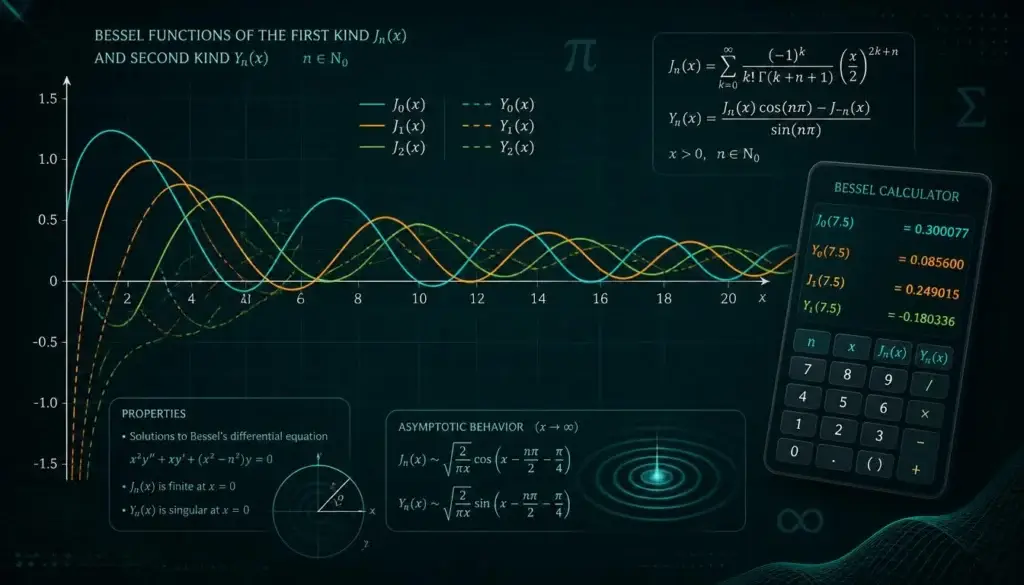
That is exactly where a bessel function calculator becomes indispensable.
In practice, I have seen engineers and students alike struggle with these functions, often resorting to interpolation from tables or writing custom code. The good news is that modern online bessel function calculator tools eliminate most of that friction. They handle the numerical heavy lifting, letting you focus on the physics or engineering problem at hand.
This guide walks through what Bessel functions actually are, how calculators compute them, when to use each type, and the practical limitations you need to keep in mind. From series expansions to real-world application examples, you will leave with a working understanding of how to use a bessel function calculator online effectively.
What Are Bessel Functions?
Bessel functions are the canonical solutions to Bessel’s differential equation:
x²y″ + xy′ + (x² − n²)y = 0
This second-order ordinary differential equation arises whenever you solve Laplace’s equation or the Helmholtz equation in cylindrical or spherical coordinates. The parameter n is called the order of the Bessel function, and it can be any real or complex number, though integer and half-integer orders appear most frequently in physical problems.
Because it is a second-order equation, there are two linearly independent solutions. These are conventionally called:
- Bessel functions of the first kind, denoted J_n(x)
- Bessel functions of the second kind, denoted Y_n(x)
There are also modified Bessel functions (I_n and K_n), which arise from a slightly different differential equation and behave more like exponentials than oscillatory functions.
Why “Cylinder Functions”?
You will sometimes hear Bessel functions called cylinder functions or cylindrical harmonics. This is because they emerge naturally when solving boundary value problems with circular or cylindrical symmetry. From experience, understanding this geometric origin makes it much easier to remember when and why to reach for these functions.
Bessel Function Calculator: What It Computes
A typical bessel function calculator handles four main function types:
- J_n(x) — Bessel function of the first kind
- Y_n(x) — Bessel function of the second kind (also called Neumann functions)
- I_n(x) — Modified Bessel function of the first kind
- K_n(x) — Modified Bessel function of the second kind
Some advanced calculators also support spherical Bessel functions, which involve half-integer orders and appear in spherical coordinate problems.
Input Parameters
Most calculators require two inputs:
- Order (n or ν): Typically an integer, but many tools accept fractional values
- Argument (x): The point at which to evaluate the function
From experience, the argument can be real or complex depending on the calculator. Complex arguments are essential for certain wave propagation and attenuation problems, though not every free tool supports them.
Output and Precision
Quality calculators display:
- The numerical result to adjustable decimal precision
- The function type and parameters used
- Sometimes a graph or plot of the function
One practical note: I always recommend checking the precision setting before relying on a result for critical design work. Most calculators default to 6–10 decimal places, which is sufficient for most engineering applications but may fall short for certain research-grade computations.
How Bessel Function Calculators Work
You might wonder what happens behind the scenes when you click “Calculate.” Understanding the computational approach helps you interpret results and recognize when something might be off.
Power Series Computation
For J_n(x) and I_n(x), calculators typically use the power series definition:
J_n(x) = Σ [(-1)^m / (m! Γ(n+m+1))] (x/2)^(2m+n)
This series converges for all finite x, though convergence can be slow for large arguments. What usually works is evaluating enough terms until the contribution becomes negligible relative to the desired precision.
Recurrence Relations
For Y_n(x) and K_n(x), direct series are more complex. Calculators often use recurrence relations to compute these from known values. The three-term recurrence for Bessel functions is:
Z_{n-1}(x) + Z_{n+1}(x) = (2n/x) Z_n(x)
where Z represents any of J, Y, I, or K.
Numerical Stability Considerations
Here is where practical experience matters. Numerical computation of Bessel functions is not entirely trivial. Some commercial software packages have historically produced inaccurate results for certain parameter combinations—particularly for Y_n(x) with large integer orders and complex arguments. While modern bessel function calculator tools have improved, it is worth being aware that extreme parameter values may push numerical methods to their limits.
The NIST Digital Library of Mathematical Functions provides extensive documentation on software and algorithms for Bessel function computation, which is a reliable reference for understanding implementation quality.
Types of Bessel Functions and When to Use Them
Bessel Functions of the First Kind: J_n(x)
J_n(x) is finite at the origin for non-negative integer orders. It oscillates and decays slowly as x increases.
When to use J_n(x):
- Problems where the solution must remain finite at the center of a cylinder
- Standing wave patterns in circular membranes
- Heat conduction in solid cylinders
Practical example: If you are analyzing the vibration modes of a circular drumhead, the radial displacement is described by J_n(kr), where k is determined by the boundary condition that the displacement vanishes at the rim.
Bessel Functions of the Second Kind: Y_n(x)
Y_n(x), also called Neumann functions, are singular at the origin. They diverge to negative infinity as x approaches zero.
When to use Y_n(x):
- Problems where the domain excludes the origin (e.g., hollow cylinders)
- Wave scattering problems
- General solutions where both linearly independent solutions are needed
Important note: In many physical problems with a solid cylinder, you discard Y_n(x) because the solution must be finite at r = 0. But for annular regions, both J_n and Y_n contribute.
Modified Bessel Functions: I_n(x) and K_n(x)
Modified Bessel functions arise from the modified Bessel equation:
x²y″ + xy′ − (x² + n²)y = 0
Unlike J and Y, which oscillate, I_n(x) grows exponentially and K_n(x) decays exponentially.
When to use modified Bessel functions:
- Diffusion problems with cylindrical symmetry
- Heat conduction in cylindrical fins
- Electric potential in cylindrical geometries with space charge
Practical example: The temperature distribution along a cylindrical cooling fin involves I_0 and K_0. From experience, recognizing whether your problem is oscillatory (J, Y) or exponential (I, K) is the first critical step in setting up the solution correctly.
Spherical Bessel Functions
Spherical Bessel functions, denoted j_n(x) and y_n(x), are related to ordinary Bessel functions of half-integer order:
j_n(x) = √(π/2x) J_{n+1/2}(x)
They appear in problems with spherical symmetry:
- Quantum scattering theory
- Electromagnetic radiation from spheres
- Acoustic scattering from spherical objects
A spherical bessel function calculator handles these directly, saving you the trouble of converting to half-integer orders manually.
Step-by-Step: Using a Bessel Function Calculator
Here is a practical framework I have refined over years of working with these tools.
Step 1: Identify the Physical Problem
Determine the geometry and boundary conditions:
- Is the domain cylindrical or spherical?
- Does the solution need to be finite at the origin?
- Is the behavior oscillatory or exponential?
Step 2: Select the Correct Function Type
Based on your physical problem:
| Physical Situation | Function Type |
|---|---|
| Finite at origin, oscillatory | J_n(x) |
| Singular at origin, oscillatory | Y_n(x) |
| Finite at origin, exponential growth | I_n(x) |
| Singular at origin, exponential decay | K_n(x) |
| Spherical geometry | j_n(x) or y_n(x) |
Step 3: Determine the Order (n)
The order comes from the separation constant in your differential equation. For integer-order problems, n is typically 0, 1, 2, etc. For spherical problems, you will use half-integer orders.
Step 4: Enter Values into the Calculator
Input your order and argument. Double-check units—Bessel function arguments are dimensionless, so make sure your physical quantities are properly normalized.
Step 5: Interpret the Result
Compare against known values for sanity checking:
- J_0(0) = 1
- J_n(0) = 0 for n > 0
- I_0(0) = 1
- Y_n(0) = −∞
Step 6: Verify with a Second Method
For critical applications, cross-check using:
- Series expansion for small arguments
- Asymptotic formulas for large arguments
- Tabulated values from NIST or Abramowitz & Stegun
Practical Applications Across Engineering Disciplines
Heat Transfer
In cylindrical coordinates, the steady-state heat equation leads to Bessel functions. The temperature distribution in a long cylinder with specified surface temperature involves J_0 and Y_0.
From experience, the most common mistake here is forgetting that Y_0 must be discarded for a solid cylinder. If your calculated temperature blows up at the center, you have almost certainly retained the wrong solution.
Electromagnetic Waveguides
Circular waveguides support transverse electric (TE) and transverse magnetic (TM) modes. The cutoff frequencies are determined by the zeros of J_n and its derivative.
A bessel function calculator with graph is particularly useful here—you can visually identify the zeros and confirm your mode calculations.
Vibrations and Acoustics
The natural frequencies of a circular membrane involve the zeros of J_n. For a drumhead, the fundamental mode corresponds to the first zero of J_0.
Quantum Mechanics
In quantum scattering, partial wave analysis uses spherical Bessel functions. The phase shifts are computed from the asymptotic behavior of j_n and y_n.
Optical Fiber Design
The mode field distribution in step-index optical fibers is described by Bessel functions in the core and modified Bessel functions in the cladding. A modified bessel function calculator is essential for computing the propagation constant and mode field diameter.
Common Mistakes and How to Avoid Them
Mistake 1: Using the Wrong Function Type
This is the most frequent error I see. J and Y are oscillatory; I and K are exponential. If your physical problem involves diffusion or attenuation, you likely need I or K, not J or Y.
Solution: Always trace back to the differential equation. The sign of the separation constant determines the function family.
Mistake 2: Ignoring Singularity at Origin
Y_n(x) and K_n(x) diverge at x = 0. If your domain includes the origin and your solution must be finite there, these functions cannot appear.
Solution: Check your boundary conditions before accepting a calculator result.
Mistake 3: Insufficient Precision
Some calculators default to low precision. For applications requiring high accuracy, adjust the precision setting.
Solution: Use a calculator that lets you specify decimal places, and verify against known values.
Mistake 4: Misunderstanding the Argument
The argument of a Bessel function is not an angle—it is a dimensionless quantity that often represents a scaled radial coordinate.
Solution: Always normalize your variables before plugging into the calculator.
Mistake 5: Overlooking Asymptotic Behavior
For very large or very small arguments, the calculator may struggle numerically. Asymptotic formulas provide better accuracy in these regimes.
Solution: Know the asymptotic forms:
- J_n(x) ~ √(2/πx) cos(x − nπ/2 − π/4) for large x
- I_n(x) ~ e^x / √(2πx) for large x
Bessel Function Calculator with Steps: What to Expect
Many users search for a bessel function calculator with steps because they want to understand the computation, not just get an answer.
Quality step-by-step calculators typically show:
- The function type and parameters
- The series expansion or recurrence relation used
- Intermediate numerical values
- The final result with specified precision
- Sometimes a graph of the function
From experience, the best calculators for learning purposes are those that display the series terms explicitly. This lets you see how many terms are needed for convergence—a valuable insight for understanding numerical behavior.
Numerical Computation: A Deeper Look
Series Convergence
The power series for J_n(x) converges for all x, but the number of terms required grows with x. For x = 10 and n = 0, you might need 20–30 terms for double precision. For x = 100, that number increases substantially.
Asymptotic Expansions
For large arguments, asymptotic expansions are more efficient:
J_n(x) ≈ √(2/πx) [cos(ω) P(n,x) − sin(ω) Q(n,x)]
where ω = x − nπ/2 − π/4, and P and Q are asymptotic series.
Recurrence Relations and Stability
The three-term recurrence relation is elegant but can be numerically unstable in certain directions. Computing J_n(x) for increasing n from J_0 and J_1 is stable; computing Y_n(x) this way is not.
What usually works for Y_n(x) is downward recurrence or direct evaluation from more sophisticated algorithms.
Software Quality
Not all calculators are created equal. The NIST Digital Library of Mathematical Functions maintains a comprehensive list of software packages with documented accuracy. When precision matters, prefer tools that reference NIST standards.
Bessel Function Table vs. Calculator: Which to Use?
Before calculators became ubiquitous, engineers relied on printed bessel function tables. These tables, such as those in Abramowitz and Stegun’s Handbook of Mathematical Functions, provided values at discrete points.
Advantages of tables:
- Verified accuracy
- No computational errors
- Historical reference
Disadvantages of tables:
- Limited to tabulated points
- Interpolation introduces error
- Not practical for complex arguments
Advantages of calculators:
- Continuous evaluation
- High precision
- Handles arbitrary orders
- Often includes graphing
Disadvantages of calculators:
- Quality varies
- Numerical issues at extremes
- Requires digital access
From experience, the best approach is to use a calculator for computation and a table for verification. If your calculator result disagrees significantly with the table, investigate before proceeding.
Modified Bessel Function Calculator: Special Considerations
Modified Bessel functions I_n(x) and K_n(x) require special attention because their behavior differs fundamentally from J and Y.
I_n(x): Exponential Growth
I_n(x) grows exponentially for large x. This can cause overflow in numerical computation if x is large.
Practical tip: Many calculators use scaled versions, denoted I_n(x) e^(−x), to avoid overflow. Check whether your calculator applies scaling.
K_n(x): Exponential Decay
K_n(x) decays exponentially and is singular at x = 0. It is the modified analog of Y_n(x).
Applications
Modified Bessel functions appear in:
- Heat conduction in cylindrical fins
- Diffusion problems
- Plasma physics
- Optical fiber mode analysis
A modified bessel function calculator that handles both I and K, with optional scaling, is essential for these applications.
Frequently Asked Questions
1. What is a Bessel function calculator used for?
A bessel function calculator computes numerical values of Bessel functions J_n(x), Y_n(x), I_n(x), and K_n(x) for given order and argument. It is used in engineering and physics problems involving cylindrical or spherical symmetry.
2. How do I calculate Bessel functions manually?
For small arguments, use the power series expansion. For large arguments, use asymptotic formulas. For intermediate values, recurrence relations or interpolation from tables work. However, manual calculation is tedious and error-prone—a calculator is far more reliable.
3. What is the difference between J and Y Bessel functions?
J_n(x) is finite at the origin and oscillates. Y_n(x) is singular at the origin and also oscillates. They are the two linearly independent solutions to Bessel’s equation.
4. When should I use modified Bessel functions instead of ordinary ones?
Use modified Bessel functions (I and K) when your differential equation has a negative sign in the separation constant, leading to exponential rather than oscillatory behavior. This occurs in diffusion, attenuation, and certain static field problems.
5. Can a Bessel function calculator handle complex arguments?
Some advanced calculators can, but many free tools cannot. Complex arguments are needed for wave propagation in lossy media and certain quantum mechanical problems.
6. What is the order of a Bessel function?
The order n (or ν) is a parameter in Bessel’s equation. It is often an integer or half-integer in physical problems, but can be any real or complex number mathematically.
7. Why does Y_n(x) go to infinity at x = 0?
Y_n(x) has a logarithmic singularity at the origin for n = 0 and a power-law singularity for n > 0. This is a mathematical property of the second solution to Bessel’s equation.
8. How accurate are online Bessel function calculators?
Accuracy varies. Reputable calculators reference NIST standards and provide 10+ decimal places. Always verify critical results with a second method.
9. What is a spherical Bessel function?
Spherical Bessel functions j_n(x) and y_n(x) are related to ordinary Bessel functions of half-integer order. They appear in problems with spherical symmetry, such as quantum scattering and electromagnetic radiation from spheres.
10. Can I use a Bessel function calculator for engineering design?
Yes, but verify results independently for critical applications. Understand the limitations of numerical computation at extreme parameter values.
11. What are the zeros of Bessel functions?
The zeros of J_n(x) are important for boundary value problems. For example, the first zero of J_0 is approximately 2.4048, which determines the fundamental frequency of a circular membrane.
12. How do I know which Bessel function to use?
Trace back to your differential equation and boundary conditions. If the solution must be finite at the origin, use J (or I). If the domain excludes the origin, both J and Y (or I and K) may contribute.
13. What is the asymptotic behavior of Bessel functions?
For large x, J_n(x) and Y_n(x) behave like decaying sinusoids. I_n(x) grows exponentially, and K_n(x) decays exponentially.
14. Are there Bessel functions of fractional order?
Yes. Fractional-order Bessel functions appear in problems with conical or wedge geometries. Many calculators support fractional orders.
15. What tools can I use besides an online calculator?
Python’s SciPy library, MATLAB, Mathematica, and specialized numerical libraries all provide Bessel function computation. For quick checks, online calculators are convenient; for production code, use a well-tested library.